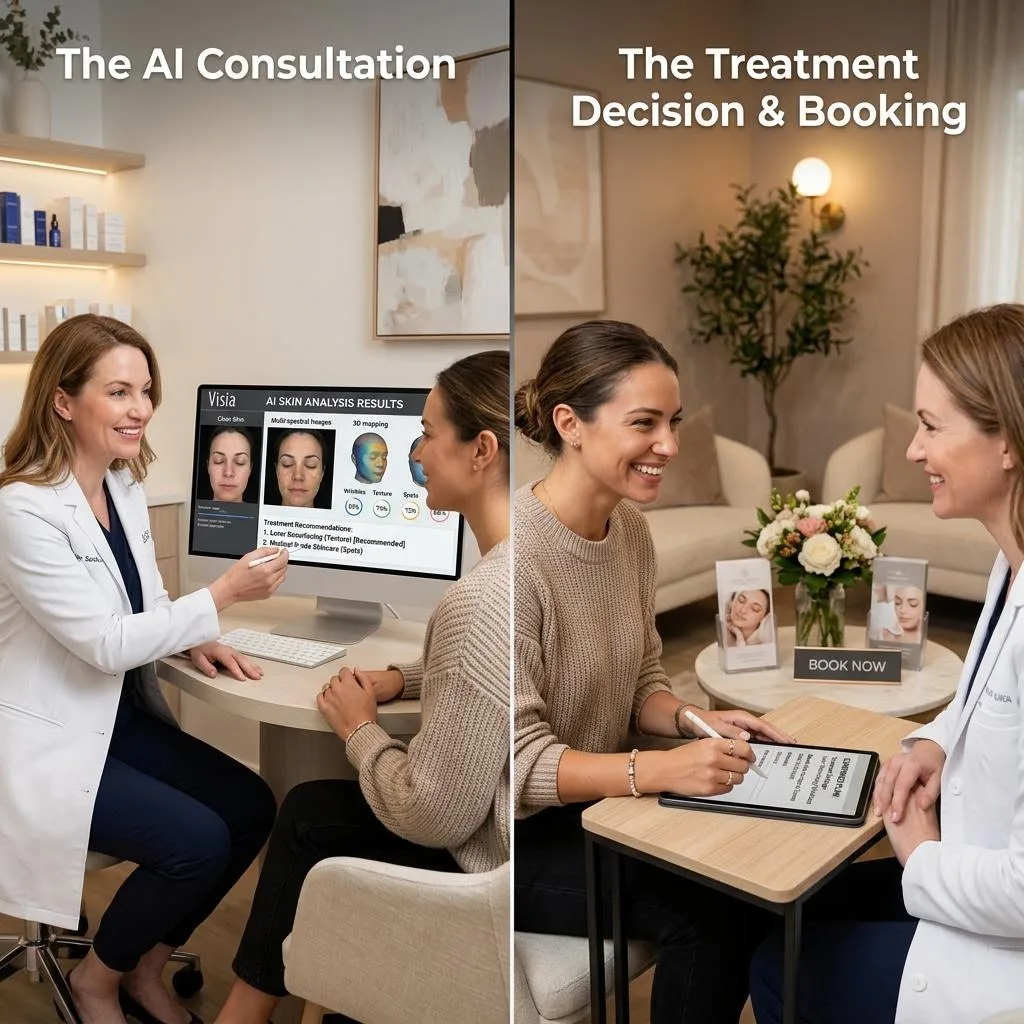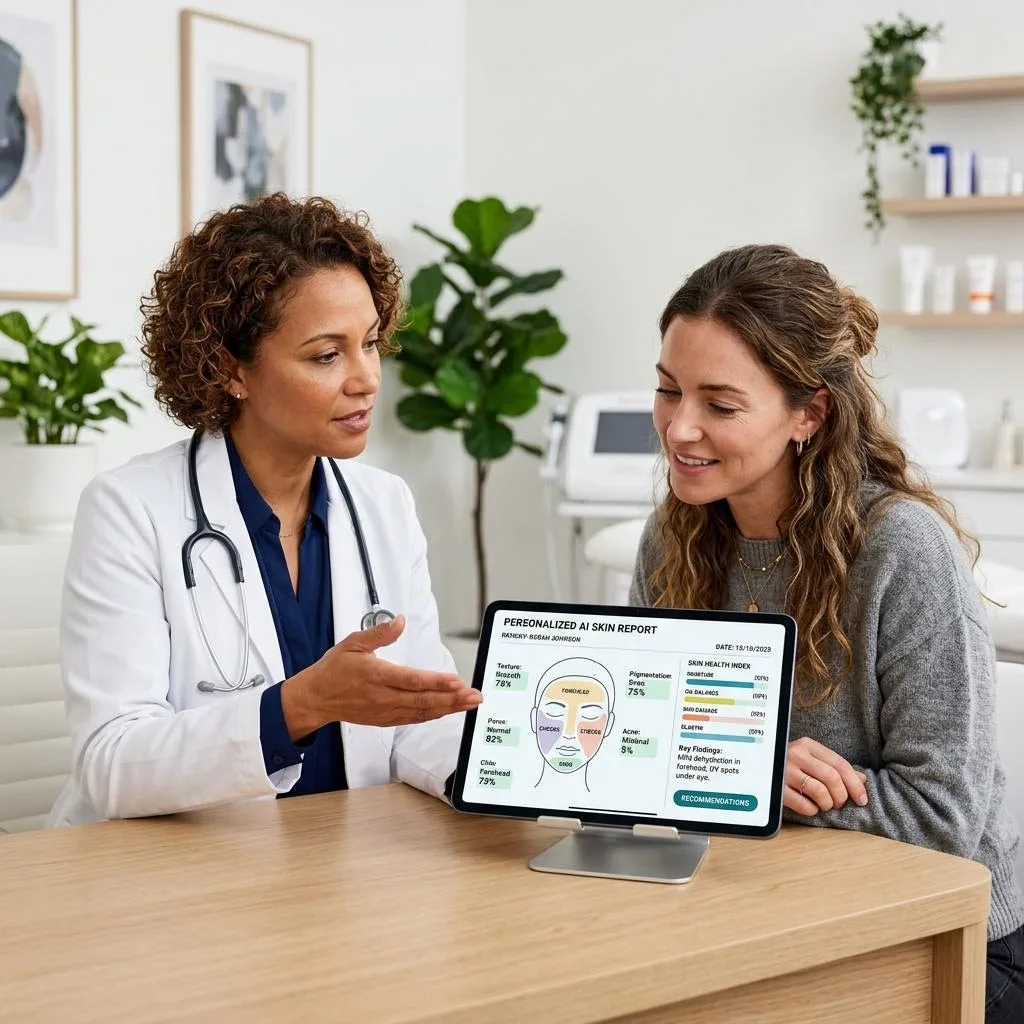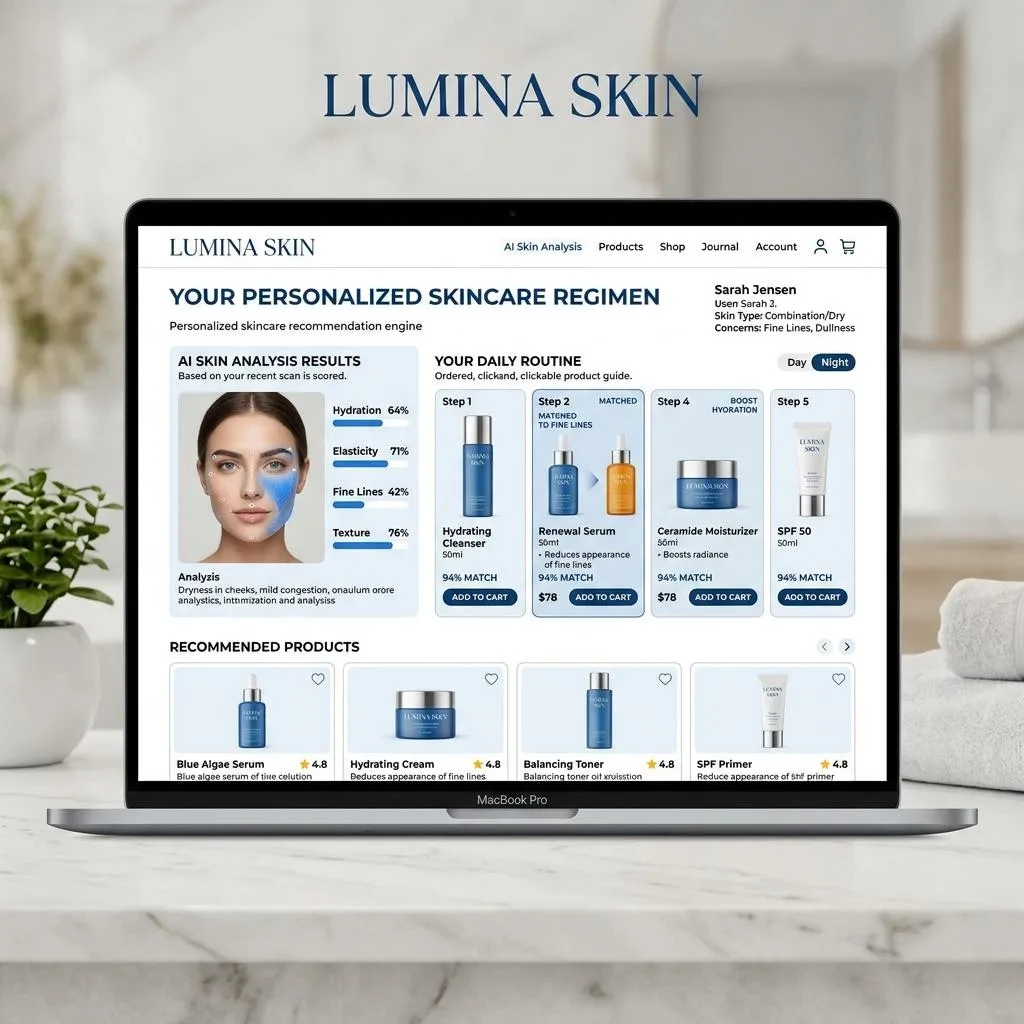
AI skin analysis for skincare brands is an AI-powered diagnostic technology that detects skin conditions — including acne, pores, pigmentation, and wrinkles — from a facial photograph, then maps detected concerns to personalised product recommendations from the brand’s own catalogue. It replaces generic “bestseller” browsing with a data-driven consultation flow that increases conversion rates, average order value, and customer retention.
Skincare brands are sitting on a conversion problem that better product photography and sharper copy cannot solve. A customer lands on a product page, reads the claims, watches the review videos — and still leaves without buying. Not because the product is wrong. Because she does not know whether it is right for her skin.
This is the gap that AI skin analysis for skincare brands closes. Not as a gimmick, but as a functional layer in the customer journey that replaces guesswork with data-backed guidance. This guide is written for brand founders, ecommerce managers, and marketing managers evaluating whether — and how — to deploy it.
Why Generic Product Pages Are Losing the Skincare Customer
The average skincare shopper abandons a site not because the price is too high, but because the choice is too uncertain. They cannot feel the texture, they do not know if the serum will suit oily or combination skin, and they have been burned by a wrong purchase before.
According to one industry estimate, the global AI skin analysis market is valued at roughly USD 1.79 billion in 2025 and is projected to reach approximately USD 7.75 billion by 2035, growing at a CAGR of about 16.98% (Glamar). Market-size estimates vary considerably by research firm — Coherent Market Insights, for example, projects USD 2.13 billion in 2026 rising to USD 6.30 billion by 2033 at a 16.8% CAGR — so treat any single figure as directional rather than definitive. Either way, the trajectory is driven largely by brand demand, not consumer novelty. Brands are investing because the numbers work: Haut.AI reports that its own customers see an average increase of roughly 34% in order (cart) value after adopting AI-based skin analysis — a vendor-reported figure that refers specifically to order value, not total sales (Haut.AI).
The traditional ecommerce funnel — Browse → Consider → Buy — treats every visitor identically. AI skin analysis restructures it into a personalised loop: Analyze → Personalize → Recommend → Buy. That loop creates a fundamentally different kind of engagement, one where the brand becomes a consultant rather than a catalogue.
What AI Skin Analysis Actually Does (and What It Does Not)
What It Detects
A production-grade AI skin analysis system does not simply tell a user whether they have “dry skin.” It performs multi-zone facial analysis — separating T-zone, U-zone, and cheek behaviour — and detects granular conditions including:
- Acne and acne-prone areas (via blob detection)
- Enlarged pores (via morphological analysis)
- Blackheads (via adaptive thresholding)
- Dark spots and hyperpigmentation (via LAB colour space analysis)
- Dullness (via light reflectance evaluation)
- Acne scars (via texture analysis)
- Fine lines and wrinkles (via edge detection)
- Skin age estimation (via texture-based analysis)
ProSkinScan, for example, uses MediaPipe Face Mesh to detect 468 facial landmarks for accurate skin mapping, turning a selfie into a structured data object that the recommendation engine can act on.

Important
Important: AI skin analysis is a clinical-quality screening tool, not a medical diagnosis. Use it to surface insights and personalise recommendations — never as a replacement for professional dermatological advice.
What It Does Not Replace
AI skin analysis is a clinical-quality screening tool, not a medical diagnosis. Results are informative and should not replace dermatological consultation for clinical conditions (app.proskinscan.com). For skincare brands, this is actually an advantage: framing the tool as a “skin profile builder” or “personalisation engine” rather than a diagnostic keeps positioning appropriate and customer expectations accurate.
The Business Case: Three Measurable Impacts
34%
Average order value lift (Haut.AI)
30%
Conversion rate increase (Perfect Corp)
4x
Higher conversion vs. standard listings (GlamAR)
Key Takeaway
Key Takeaway: Haut.AI reports that its own customers see an average increase of roughly 34% in order (cart) value after adding AI-based skin analysis — a lift driven by a conversion flow you cannot replicate with better product photography or sharper copy alone.
1. Conversion Rate Improvement
When a recommendation is personalised to detected skin conditions — rather than a brand-wide “bestseller” list — purchase confidence rises. Perfect Corp reports up to a 30% increase in conversion rates and sales from AI skin diagnostics deployment (vendor-reported). GlamAR, separately, claims conversion-rate increases of up to 4x compared with standard product listing pages (also a vendor claim).
For a mid-size brand with 50,000 monthly visitors and a 2% baseline conversion rate, a 30% uplift means 300 additional monthly transactions — at zero additional acquisition cost.
2. Average Order Value (AOV) Growth
Personalised analysis naturally generates routine recommendations rather than single-product suggestions. When a brand’s AI identifies that a customer has dullness plus mild hyperpigmentation plus enlarged pores, the recommended routine includes a cleanser, a targeted serum, and an SPF product — not just the serum. Haut.AI reports an average increase of roughly 34% in order value in implementations using AI-driven routines (Haut.AI’s own figure; note that the “add-to-cart rate” phrasing found in some secondary sources is a misstatement of this order-value metric).
3. Customer Retention and First-Party Data
Every skin scan creates a data record. Over time, repeat scans show progress — or regression — giving the brand an ongoing reason to communicate with customers beyond seasonal promotions. This is first-party data, collected with explicit consent, that belongs to the brand rather than a third-party platform. In a post-cookie environment, that longitudinal skin profile is a competitive moat.
Common Mistakes Skincare Brands Make When Deploying AI Skin Analysis
Mistake 1: Treating It as a Novelty Widget
Brands that bury the skin analysis tool in a “Try It” tab at the bottom of the page see minimal impact. The tool needs to sit at the start of the shopping journey — on the homepage hero, on category pages, or as a gateway to product recommendations — not as an afterthought.
Mistake 2: Failing to Connect Analysis to Inventory
An AI scan that recommends “a gentle hyaluronic serum for dehydrated skin” but does not link directly to the brand’s own SKU has failed its core job. The recommendation engine must be mapped to the actual product catalogue. Without this mapping, the tool increases awareness but not conversions.
Mistake 3: Requiring Account Registration Before the Scan
Every friction point before the scan reduces completion rates. Brands that gate the skin analysis behind a sign-up form see abandonment rates spike. The optimal flow: scan first, collect email as part of results delivery. This framing — “your skin report will be emailed to you” — converts lead capture into a value exchange.
Mistake 4: Using a One-Size Accuracy Bar
A D2C skincare brand selling brightening serums does not need the same depth of clinical analysis as an aesthetics clinic managing post-procedure care. Deploying over-engineered technology at the D2C layer adds cost without proportionate commercial return. Right-sizing the solution to the use case matters.
A Smarter Deployment Strategy for Skincare Brands
Entry Point Placement
Homepage hero or "Shop by Concern" CTA
Routine-First Output
Full routine stack, not one product
Post-Scan Nurture
4-email sequence from scan data
Progress Tracking
Rescan at 6–8 weeks, show the delta
Phase 1: Entry Point Placement
Integrate the skin analysis tool as the primary homepage CTA or as the first step in the “Shop by Concern” navigation. The objective is to intercept the customer before she browses — not after she is already lost in category pages.
Phase 2: Routine-First Recommendation Architecture
Build the output page as a skin profile summary + routine stack, not a single-product card. Show the customer’s detected concerns, explain the logic (“your T-zone shows enlarged pores; here is why a niacinamide toner helps”), and present the full routine with add-to-cart functionality on a single page.
Phase 3: Post-Scan Email Sequence
Use the results delivery email as the start of a nurture sequence. Email 1: skin report. Email 2: education on the detected conditions. Email 3: before/after testimonials from customers with similar profiles. Email 4: limited-time offer on the recommended routine. This sequence has a logical content arc because it starts from the customer’s own data.
Pro Tip
Pro Tip: Six to eight weeks after the first scan, prompt the customer to rescan. Longitudinal data turns a one-off purchase into a reason to keep returning — and gives you first-party insights no static quiz can match.
Phase 4: Progress Tracking Loop
Six to eight weeks after the first scan, prompt the customer to rescan. Show the delta. If the routine is working, the data demonstrates it — turning the brand into a trusted partner in the customer’s long-term skin journey, not a transactional vendor.
Implementation Considerations: What to Evaluate Before Choosing a Platform
Integration method: Does the solution offer a JavaScript embed, an API, or a full SDK? For ecommerce brands on Shopify, WooCommerce, or custom platforms, ease of integration determines time-to-launch — which can range from days to weeks depending on the provider (PerfectCorp).
Catalogue mapping: Can the recommendation engine be configured to map directly to your product IDs, SKUs, and concern categories? Generic recommendations reduce commercial impact.
Mobile performance: Most skincare customers complete transactions on mobile. The scan interface must perform reliably on smartphone cameras, including in variable lighting.
Data compliance: Customer facial data is sensitive. Verify that the provider operates GDPR-ready and HIPAA-ready infrastructure (PerfectCorp). ProSkinScan processes facial photos only for analysis and does not store or share them (app.proskinscan.com).
Brand control: The analysis interface should be brandable — colours, fonts, and tone consistent with the brand identity. An off-brand skin analysis experience undermines the trust it is designed to build.
Buying Signals: You Are Ready for AI Skin Analysis When…
- Your ecommerce conversion rate is below 3% despite strong traffic
- You are receiving “which product is right for me?” questions frequently via chat or email
- Your return rate on skincare products exceeds 10–15%
- You are launching a new product line and need a data-driven way to match customers to SKUs
- You are preparing a loyalty or CRM programme and need a first-party data engine
- Competitor brands in your category have already deployed personalisation tools and are gaining ground
Frequently Asked Questions
Q1: How accurate is AI skin analysis compared to a dermatologist consultation?
Leading AI skin analysis platforms report high test-retest reliability — vendors such as Haut.AI and Perfect Corp cite consistency figures around 95% — when image quality is controlled (bright lighting, clean face, no makeup, full face in frame). It is important to read this correctly: that number reflects how consistently the tool reproduces its own measurements, not a one-to-one accuracy comparison against a dermatologist’s diagnosis. For commercial use — product recommendations, routine building — this consistency level is more than sufficient. For clinical diagnosis, dermatologist review remains the appropriate standard.
Q2: How long does it take to integrate AI skin analysis into an existing ecommerce site?
Integration timelines range from a few days (for plug-and-play embeds) to several weeks (for API-based integrations with custom UX). White-label platforms designed for brand deployment have reduced time-to-market from months or years to weeks by eliminating the need to build proprietary ML models in-house (PerfectCorp).
Q3: Does AI skin analysis work for all skin tones and types?
Quality matters here. AI models trained on small or demographically narrow datasets perform poorly on darker skin tones and on Asian skin types specifically. When evaluating a provider, ask for data on dataset diversity and accuracy metrics across Fitzpatrick skin types. ProSkinScan is built with analysis capabilities designed for diverse skin profiles (ProSkinScan).
Q4: Can AI skin analysis be used in marketing campaigns, not just the ecommerce store?
Yes — and this is an underutilised application. QR codes on packaging that trigger a skin scan, email campaigns where “your skin scan is ready” is the subject line, and social ads that drive directly to a scan flow rather than a product page all perform above category benchmarks. The scan creates engagement that product photography alone cannot.
Q5: What data does the customer need to provide?
The minimal viable input is a selfie — a single facial photograph taken with a smartphone or webcam. No personal data is required for the scan itself. Email collection, if used, happens at the results delivery stage as a value exchange for the skin report.
Q6: How does AI skin analysis affect return rates?
Brands using AI-driven personalisation report lower return rates because customers make purchase decisions based on skin-specific data rather than generic product descriptions. When a customer understands why a specific serum suits her combination-oily skin, the purchase is more intentional — and the satisfaction rate rises accordingly.
Q7: Is there a minimum catalogue size needed for the recommendation engine to be useful?
No hard minimum, but a catalogue of at least 10–20 SKUs covering multiple concern categories (hydration, acne, pigmentation, ageing, sensitivity) enables meaningfully differentiated routine recommendations. Brands with narrower ranges can still benefit by using the scan to match customers to the most appropriate SKU within a limited line.
The Practical Step Forward
AI skin analysis for skincare brands is not a future-state technology. It is in production at brands ranging from L’Oréal Paris and Neutrogena to independent D2C labels (Glamar), and the commercial data behind it — conversion lifts, AOV increases, first-party data collection — is real and replicable.
The question for brand operators is not whether to deploy it, but which platform to deploy and in which phase of the customer journey to anchor it.
ProSkinScan is an AI skin analysis platform built specifically for skincare brands and aesthetic clinics. It delivers automated skin diagnostics mapped directly to brand product catalogues, operable 24/7 without the overhead of a physical consultation.
Experience the analysis flow firsthand before making any integration decision — the demo requires nothing beyond a selfie: Try the ProSkinScan demo →