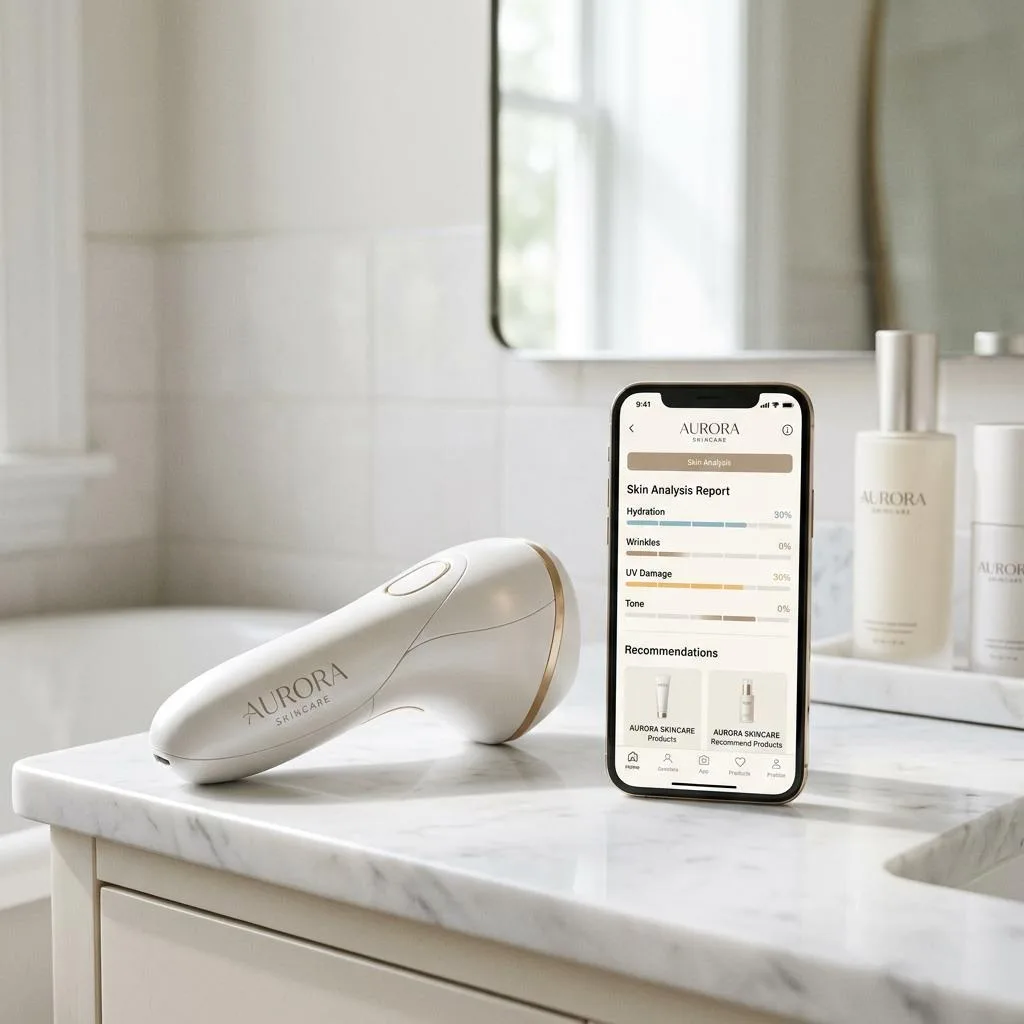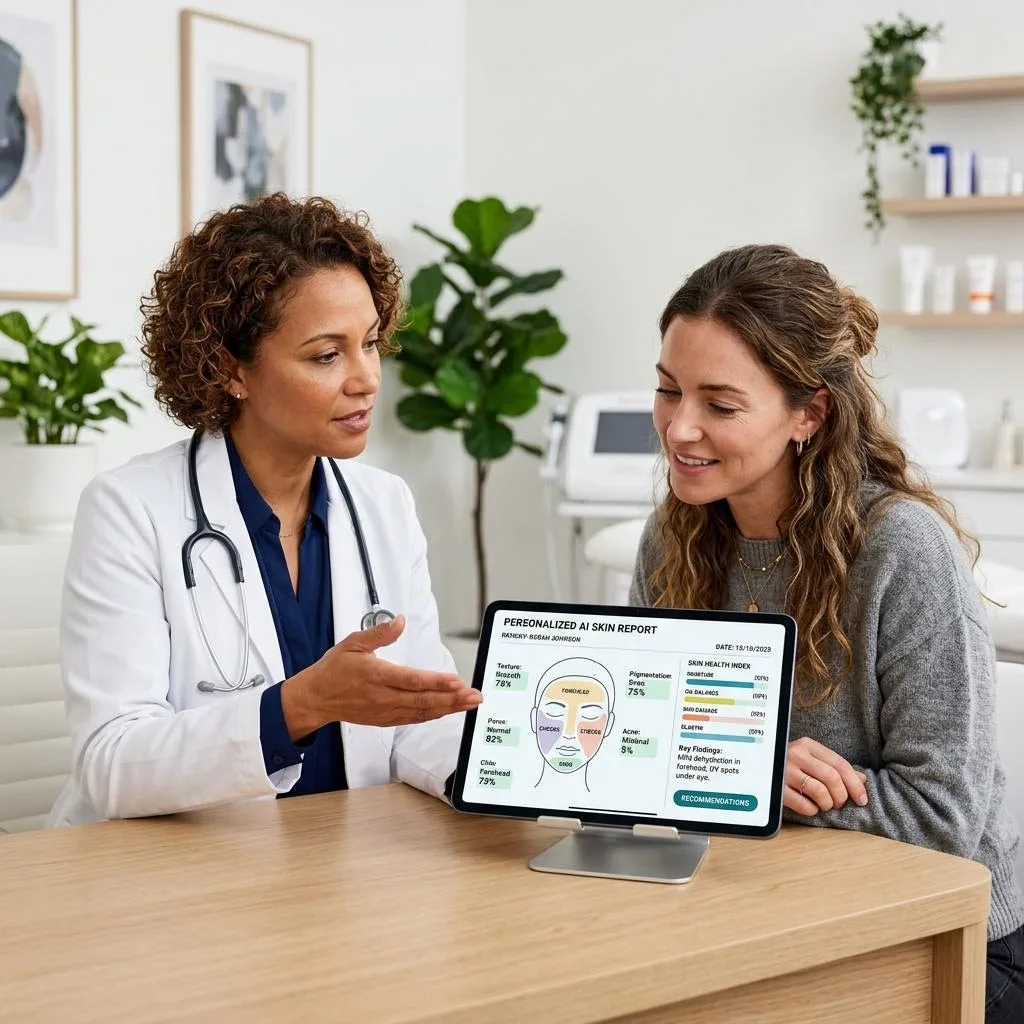
A personalized skin report is an AI-generated analysis of an individual’s skin condition, produced from a facial photo and covering 10 or more parameters — including skin type, pigmentation, texture, hydration, pore size, and acne indicators — broken down by facial zone and formatted as a client-facing document for use in aesthetic consultations and treatment planning.
The consultation is the most important revenue moment in an aesthetic clinic. It is where treatment plans are built, client trust is established, and purchasing decisions are made. It is also, in most clinics, the step that relies most heavily on the practitioner’s ability to explain invisible problems and persuade a client to invest in solutions they cannot yet see.
That persuasion challenge has a quantifiable cost. Clients who do not fully understand their skin condition are more likely to delay treatment, under-invest in a treatment plan, or fail to return for follow-up sessions. Personalized skin reports — generated by AI skin analysis at the consultation stage — are changing the structure of that conversation in clinics that have deployed them.
The Consultation Problem Most Clinics Are Not Measuring
Here is a situation most aesthetic clinicians will recognise: a new client books a consultation for “skin brightening” or “anti-ageing.” The practitioner performs a visual assessment, identifies that the client actually has significant UV damage, irregular melanin distribution, dehydration, and early textural changes — a multi-treatment situation. The practitioner explains this verbally. The client nods, says she will think about it, and books one session.
Three months later the client returns, underwhelmed by the result of a single treatment that was never designed to address her full skin picture. She does not rebook. She does not refer friends.
The failure point was not the treatment. It was the consultation — specifically, the absence of a shared, objective, visual record of the client’s skin condition that would have made the multi-treatment recommendation concrete and credible rather than abstract and sales-feeling.
A personalized skin report solves exactly this problem. It makes the invisible visible — UV damage, subcutaneous pigmentation, pore congestion, hydration gradients — in a format the client can see, read, and take home.
Key Takeaway
Key Takeaway: A mature report workflow pairs the AI scan with a follow-up scan every 3–4 treatment sessions — exactly enough interval for measurable changes, which makes the report a retention architecture, not just a one-off consultation aid.
What a Personalized AI Skin Report Contains
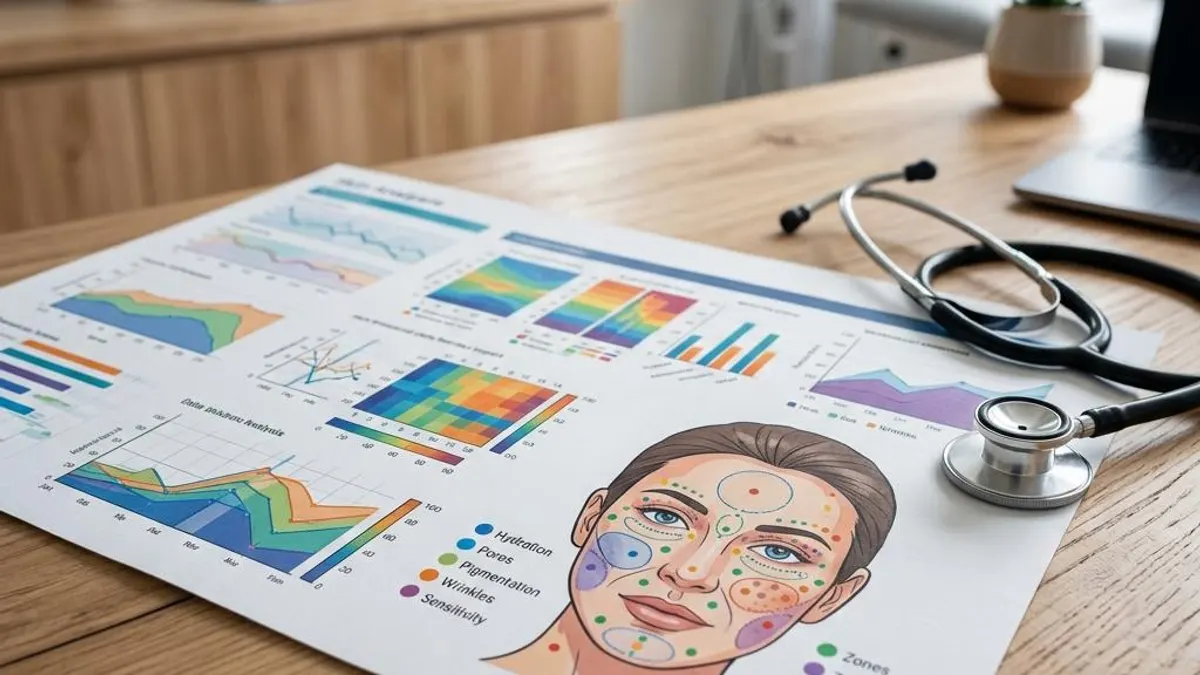
The clinical value of a personalized skin report scales directly with its analytical depth. A report that produces a single “combination skin” label adds little to what a practitioner can determine by looking. A report that provides zone-by-zone analysis of multiple distinct parameters gives the practitioner new information and gives the client a document they could not have produced without the clinic.
The QDerma AI Face & Hair Analysis clinic tool, powered by ProSkinScan, generates personalised recommendations for clinic treatments based on AI analysis of both facial skin and hair concerns — covering the range of conditions that aesthetic clinics and wellness clinics routinely address:
- Surface layer concerns — texture irregularities, dullness, visible pore size, blackhead distribution
- Pigmentation mapping — active hyperpigmentation, post-inflammatory spots, UV-induced discolouration
- Acne status — active acne, acne-prone zones, scar tissue presence
- Hydration and radiance indicators — light reflectance analysis for skin brightness assessment
- Wrinkle and fine line mapping — zone-specific ageing pattern identification
- Skin age estimation — texture-based analysis used to contextualise treatment urgency
- Hair and scalp concerns — for clinics offering hair restoration or scalp treatment protocols
10+
Skin parameters analyzed per report
468
Facial landmarks mapped per scan
Every 3–4
Treatment sessions between progress rescans
AW Medspa’s clinical experience with digital skin analysis technology demonstrates the breadth of what modern skin analysis surfaces: spots, pores, texture irregularities, wrinkles, redness, brown spots, UV spots, and bacteria/porphyrins (the latter being particularly relevant for acne-treatment planning). These are not parameters a visual inspection reliably identifies — particularly UV spots and porphyrins, which require imaging beyond what the naked eye can detect.
The key distinction from a generic assessment is the zone-level and parameter-level specificity. ProSkinScan uses 468-point facial landmark detection via MediaPipe Face Mesh, analysing the T-zone, U-zone, and cheek areas independently. A client with dry-patch dehydration on the cheeks and oiliness in the T-zone receives a report that acknowledges both realities, not a single “combination skin” label.
How Personalized Skin Reports Change the Consultation Structure
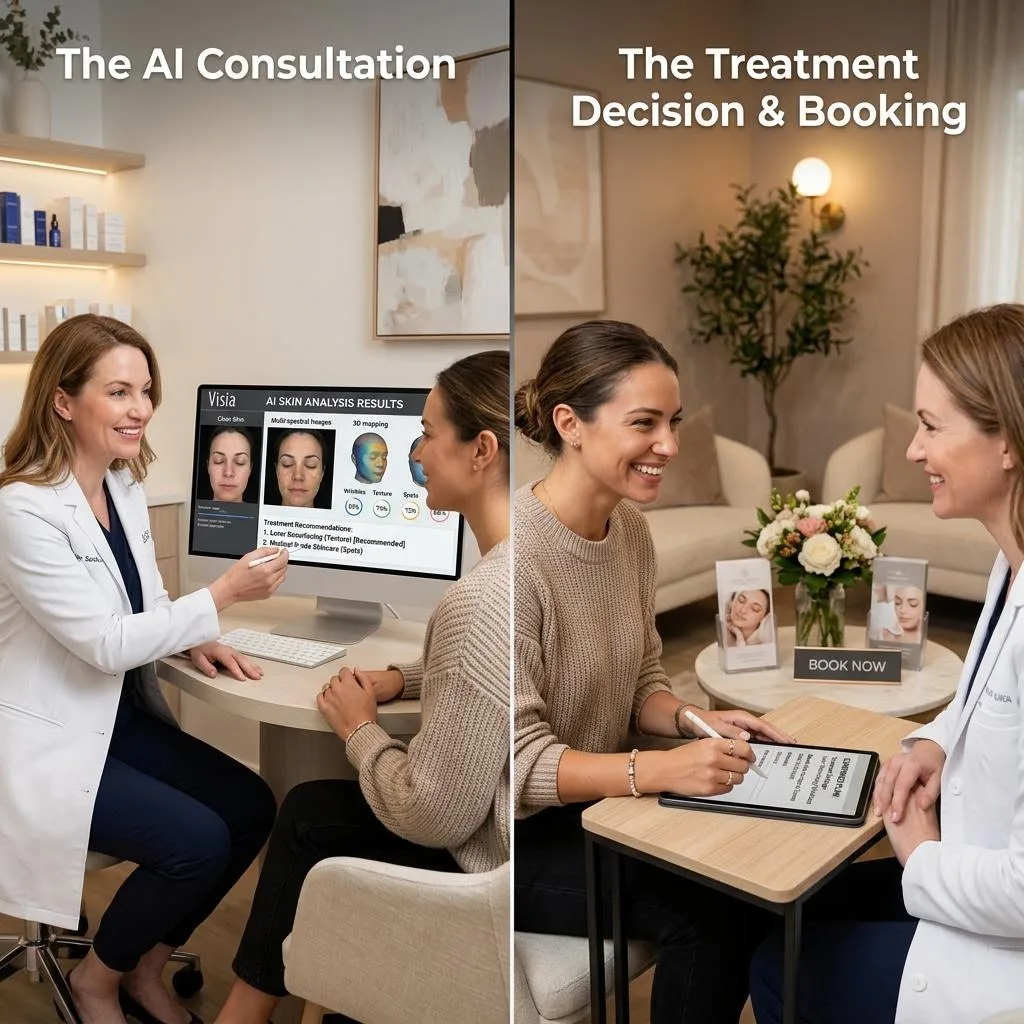
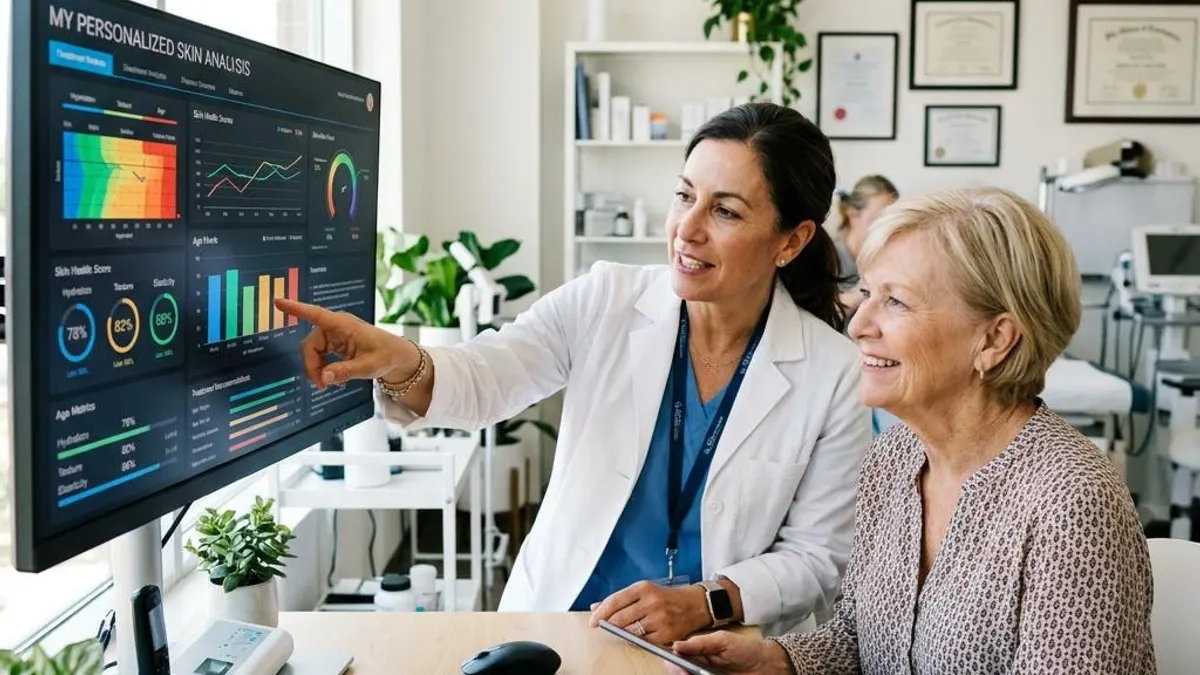
The consultation workflow shift is straightforward in practice. The client arrives — clean face, good lighting. Before the practitioner-led consultation begins, the client completes a two-minute AI scan. By the time the practitioner engages, there is a printed or screen-displayed report on the table showing the client’s skin condition across ten or more parameters.
The practitioner’s role shifts from explaining problems to interpreting findings. “The analysis shows that you have significant UV pigmentation in the left cheek area and elevated porphyrin activity in the T-zone — that combination tells us you need both a brightening protocol and acne-bacteria management” is a different sentence from “I can see some sun damage and you mentioned you’ve been breaking out.” The first sentence is a clinical briefing. The second is a guess dressed as an observation.
AW Medspa typically runs these consultations as 30–60 minute sessions, recommending analysis every 3–4 treatments to track progress and adjust the treatment plan accordingly. The follow-up scan is where the retention mechanism becomes concrete: a client who sees objective evidence that her hyperpigmentation has reduced by a measurable degree over three sessions has a data-driven reason to continue treatment that no verbal reassurance can replicate.
The Treatment Planning Advantage
Personalized skin reports directly improve treatment planning by matching modality to condition rather than matching client complaint to standard protocol.
A client who arrives complaining of “dull skin” might, on analysis, present with:
- Dehydration + low radiance → priority intervention: hydration-focused facial or injectables
- Post-inflammatory hyperpigmentation → priority intervention: laser or chemical peel brightening
- Active bacteria + comedones → priority intervention: acne protocol before brightening
- UV damage + textural irregularity → priority intervention: laser resurfacing, not topical brightening
Each of these paths involves different treatment modalities, different timelines, and different pricing. A practitioner working from a report rather than from a complaint-driven conversation makes a better clinical recommendation and builds a more defensible treatment plan — one the client can see the logic of.
AW Medspa’s protocol explicitly uses analysis results to guide recommendations across targeted facials, laser treatments, microneedling, chemical peels, and topical skincare products — a multi-modal treatment architecture that requires condition-specific data to plan correctly.
Common Mistakes Clinics Make with Skin Analysis Reports
Mistake 1: Using analysis as a selling tool rather than a clinical tool. Clients can detect when a diagnostic is being used to justify a pre-decided upsell. Reports are most effective when the practitioner leads with what the data shows — including findings that might not require immediate treatment — before presenting a treatment plan.
Mistake 2: Printing a report and setting it aside. The report should be the spine of the consultation conversation. Clinics that walk the client through each parameter see higher treatment acceptance than clinics that present the report as a formality.
Mistake 3: Not using baseline reports for retention. The most underused application of AI skin analysis in clinics is the progress comparison. A client who has a baseline scan on consultation visit one and a follow-up scan at session three has objective data showing whether treatment is working. That data is the most powerful retention tool the clinic has.
Mistake 4: Treating the report as a one-size-fits-all document. For aesthetic clinics that offer both skin treatments and hair or scalp treatments, the report should span both analysis categories.
Smarter Strategy: The Report as a Retention Architecture
The clinics building the strongest retention around AI skin reports are thinking in treatment cycles, not single sessions. The cadence looks like this:
Session 0: Baseline
Full report, treatment plan set
Sessions 1–2
Treatment delivery, no rescan
Sessions 3–4
Progress scan vs. baseline
Session 6+: Maintenance
Quarterly scans, long-term trajectory
This rhythm makes each scan a reason to return. The report is not a one-time diagnostic — it is a longitudinal record of the clinic’s impact on the client’s skin.
Pro Tip
Pro Tip: Run the scan as the first step of the consultation — before the verbal discussion — so the practitioner and client review the same objective data, making the recommended plan easier to agree on and commit to.
Implementation Considerations for Clinic Deployment
Hardware: AI skin analysis via smartphone or webcam requires no specialised hardware beyond a good lighting setup. Dedicated clinic tablets with standardised lighting (ring light, clean background) produce more consistent scan quality. ProSkinScan operates as a web application — no hardware installation beyond a browser-capable device.
Consultation flow integration: The scan works best as the first step of the consultation, before the practitioner assessment, so the practitioner is interpreting the report rather than confirming what they already know. Clients should be informed at booking to arrive without makeup.
Report delivery: Screen display during consultation plus an emailed report link for the client to review at home creates a post-visit touchpoint that reduces the “I’ll think about it” attrition that follows verbal-only consultations.
Hair analysis integration: For clinics offering hair or scalp treatments, the QDerma demo demonstrates how face and hair analysis can be combined in a single session.
Compliance: Client skin images processed for analysis should be covered by the clinic’s existing informed consent framework. Photo retention policies should default to no post-analysis storage unless the client has explicitly consented to longitudinal tracking.
Buying and Evaluation Signals for Clinic Managers
| Evaluation Criterion | What to Look For |
|---|---|
| Analysis depth | 10+ parameters; zone-level, not single skin-type label |
| Report format | Printable / email-deliverable client-facing report |
| Hair analysis capability | Face AND hair/scalp coverage for full-service clinics |
| Baseline comparison | Ability to compare current scan against previous scan |
| Branding | White-label report with clinic branding, not platform logo |
| Integration method | Web-based (no install), tablet-optimised |
| Photo retention policy | Clear no-storage default; patient consent architecture |
| Training data | Southeast Asian skin and scalp profile representation |
Important
Important: Report findings should be interpreted by a trained practitioner, not used as a standalone clinical determination. Always fold the scan into professional assessment, never present it as a diagnosis.
FAQ: Personalized Skin Reports for Aesthetic Clinics
Q1: What is the difference between a personalized skin report and a standard skin consultation?
A standard consultation is practitioner-subjective. A personalized skin report adds an objective, quantified AI layer — parameters like pore size, pigmentation distribution, UV damage markers, and hydration levels measured consistently regardless of who is conducting the consultation. The report gives clinical judgment a better-structured information input.
Q2: How does a personalized skin report improve treatment acceptance rates?
Clients accept multi-session treatment plans more readily when the basis for that recommendation is visible and concrete. A report showing that UV spots and post-inflammatory pigmentation are present in distinct zones makes the case for a combined treatment protocol more effectively than a verbal explanation alone.
Q3: Can personalized skin reports be used for hair and scalp treatment consultations?
Yes. The QDerma AI Face & Hair Analysis platform covers both face analysis and hair/scalp concern detection in the same consultation session — suitable for clinics offering hair restoration, PRP scalp treatments, or scalp analysis.
Q4: How frequently should a clinic run follow-up skin scans for existing clients?
A follow-up scan every 3–4 treatment sessions provides enough interval for measurable changes to appear in the report data. Quarterly scans work well for maintenance-phase clients.
Q5: Does AI skin analysis produce medically reliable results, or is it informational only?
AI skin analysis at this technology level produces results calibrated for clinical consultation support, not for medical diagnosis or prescribing. It identifies condition indicators with sufficient accuracy to inform treatment planning decisions — but findings should be interpreted by a trained practitioner, not used as a standalone clinical determination.
Q6: Can smaller clinics implement AI skin reporting without a dedicated technology team?
Yes. Web-based platforms like ProSkinScan require no installation, no dedicated hardware, and no technical maintenance. A tablet, a ring light, and a browser is the full technical requirement for basic deployment. Staff training typically takes a single session.
Q7: How does a personalized skin report factor into client retention strategy?
The baseline-versus-follow-up comparison is the most powerful retention mechanism. A client who can see objective evidence of skin improvement — reduced hyperpigmentation score, lower acne activity reading, improved hydration indicator — has a data-backed reason to continue her treatment plan.
Q8: What should a clinic include in its consent framework when using AI skin analysis?
At minimum: disclosure that a facial photo will be processed by AI, specification of what data is extracted versus stored, clear statement of whether images are retained post-analysis, and client consent for baseline comparison data if the clinic is tracking longitudinal skin changes.
Elevate Your Consultations with AI-Powered Skin Reports
ProSkinScan is designed for the aesthetic clinic consultation context — generating detailed, brandable skin reports from a single facial scan, covering skin and hair concerns, with no hardware installation and no dedicated IT infrastructure required.
The platform uses 468-point facial landmark detection to deliver zone-level analysis that your practitioners can actually use to build better treatment plans — not generic skin-type labels that add nothing to a trained clinician’s visual assessment.
See the full clinic consultation experience at QDerma’s AI Face & Hair Analysis demo — the same technology deployed at a live aesthetic clinic, available to explore right now.