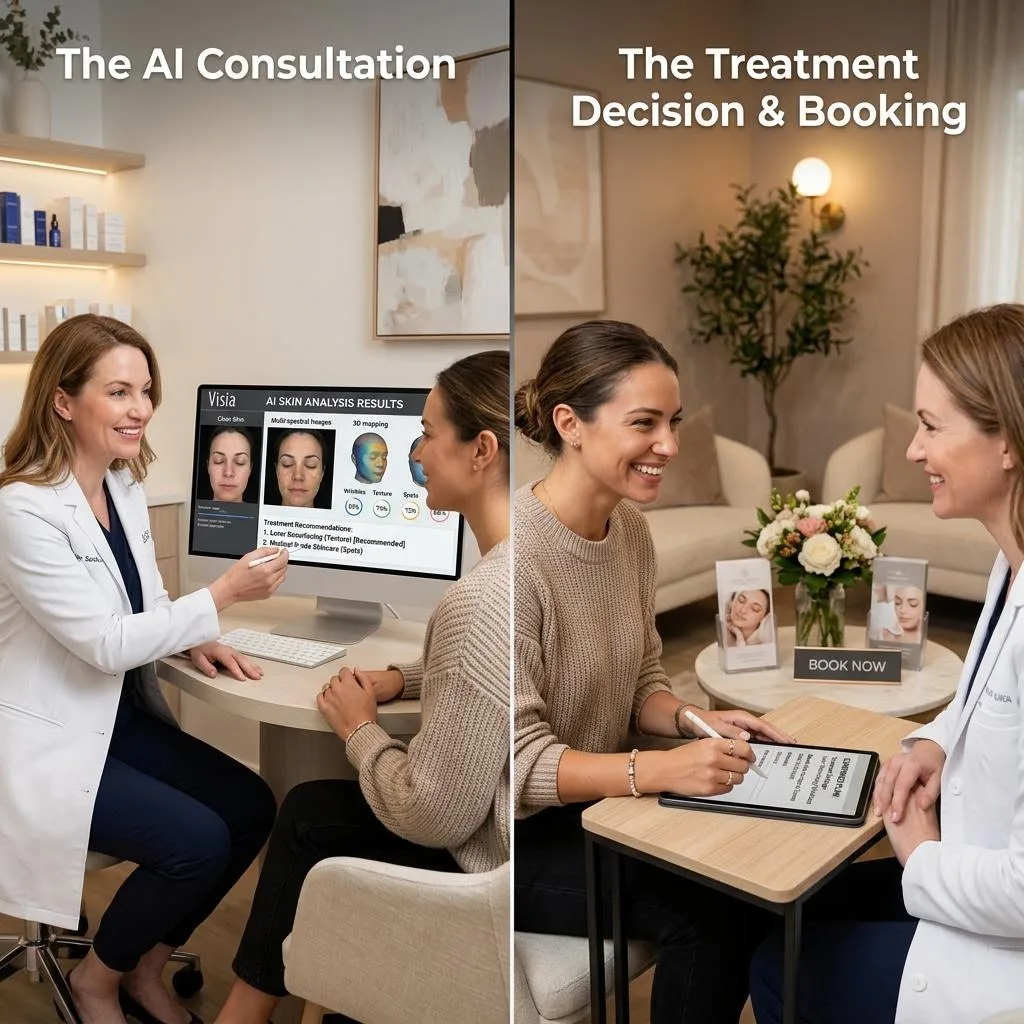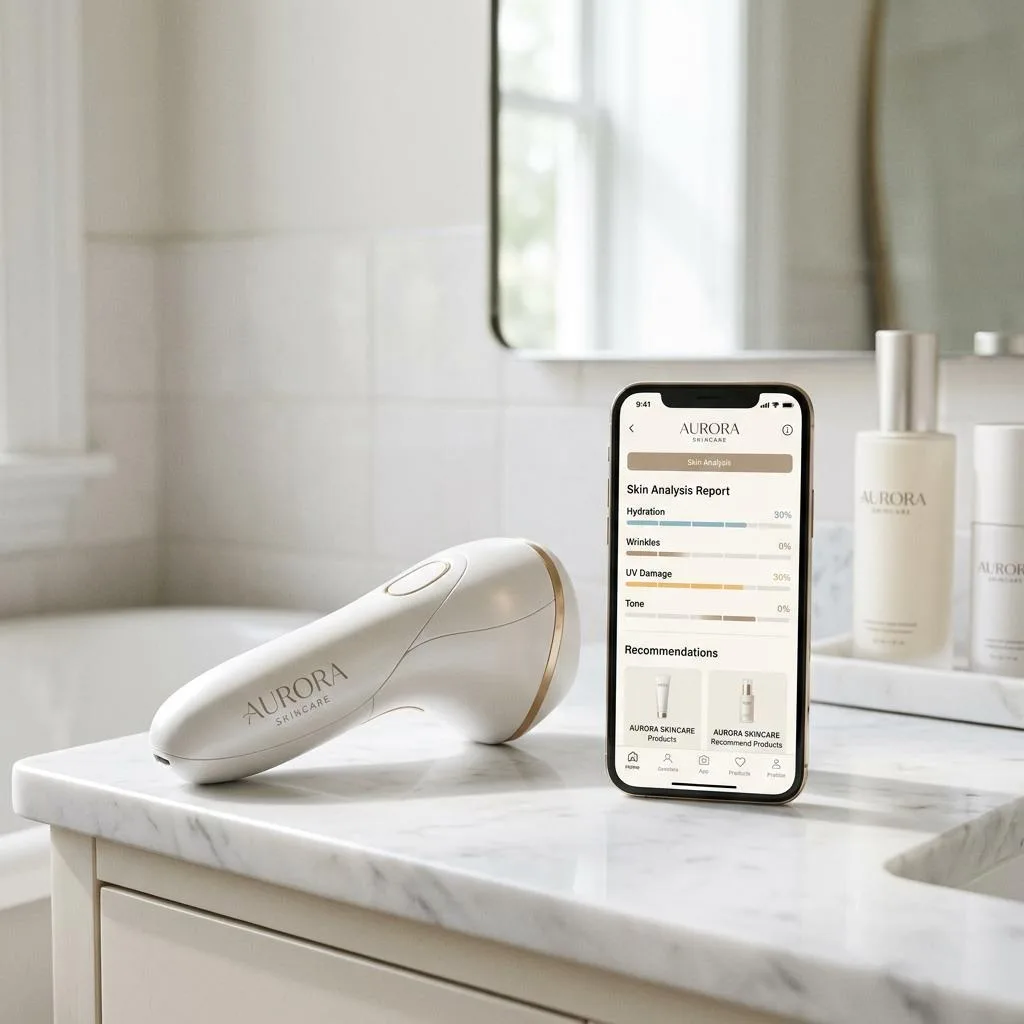
An AI skin scanner for private label skincare is a software platform that analyses a customer’s facial photo using computer vision, identifies specific skin concerns across multiple zones, and maps those findings to a brand’s product catalogue to generate personalised product recommendations — replacing generic category filters with data-driven matching.
Private label skincare is one of the most crowded segments in the beauty industry. Walk through any trade show floor — or browse any Tokopedia store category — and you will find dozens of brands sourcing from the same maklon labs, using nearly identical formulations, and competing almost entirely on packaging and price. That race to the bottom has a predictable ending.
The manufacturers and brand operators who are pulling ahead are not finding better factories. They are building a layer of intelligence between their product catalogue and their end customer: an AI skin scanner embedded directly into their brand experience. This article is a practical brief for skincare manufacturers, maklon labs, and brand operators who want to understand what that technology actually does, whether the business case holds up at realistic volumes, and what a deployment genuinely looks like.
Why Generic Product Matching Is Breaking Down
A mid-size local skincare brand — let’s call it a typical 50 SKU line — faces a structural problem. A customer lands on the brand’s website or marketplace store. She has combination skin with T-zone oiliness, active hyperpigmentation from post-acne marks, and sensitivity around the cheeks. The brand has products that would genuinely help each of those concerns. But without a mechanism to surface the right SKUs for her specific profile, she is presented with a category grid and generic “for combination skin” filter labels.
The result: she bounces, buys the wrong product and is disappointed, or makes a reasonable guess and gets a mediocre result. None of these outcomes build the repeat-purchase loyalty that private label brands depend on. The problem is not the formulation. It is the matching layer — or rather, the absence of one.
An AI skin scanner closes that gap. It takes a facial photo, runs a multi-parameter analysis across skin type, texture, hydration indicators, pigmentation, pore size, acne presence, and visible ageing markers, then maps those findings against the brand’s own product catalogue to generate a ranked recommendation set personalised to that individual.
Key Takeaway
Key Takeaway: A skin scanner maps 468 facial landmarks across the T-zone, U-zone, and cheeks to detect conditions objectively — turning subjective claims into a data-driven product match that packaging and price alone cannot replicate.
What the Technology Actually Analyses
Modern AI skin analysis platforms operate at a level of precision that was commercially inaccessible to all but the largest global brands three years ago. ProSkinScan, for instance, uses MediaPipe Face Mesh to detect 468 facial landmarks, enabling granular zone-by-zone analysis across the T-zone, U-zone, and cheeks independently — a meaningfully different output from a single “skin type” label.
The analysis parameters typically cover:
- Skin type classification — oily, dry, combination, normal, sensitive
- Acne and comedone detection — blob detection for active acne, adaptive thresholding for blackheads
- Pigmentation and dark spot analysis — LAB colour space analysis for hyperpigmentation mapping
- Texture and scar tissue — edge detection and morphological analysis for pore size and scar patterns
- Dullness and radiance — light reflectance evaluation
- Estimated skin age — texture-based analysis used to calibrate anti-ageing recommendation intensity
- Wrinkle mapping — fine line and wrinkle detection across facial zones
For a private label manufacturer, the value of this depth is not academic. A brand with a 12-SKU brightening line and a 15-SKU acne line needs the analysis to distinguish between a customer with hormonal acne on her jawline (who needs the active-acne range) versus a customer with post-inflammatory hyperpigmentation from old breakouts (who needs the brightening range). Without that discrimination, both customers get the same recommendation and one of them gets the wrong product.

The Business Case for Manufacturers and Maklon Labs
On cost: white-label AI skin analysis platforms are deployed as APIs or embedded SDKs that integrate into an existing website, app, or even a QR code linked from product packaging. Perfect Corp’s enterprise data shows that brands using AI skin analysis report higher conversion rates, increased average order value, and improved customer retention — without building the underlying AI infrastructure in-house. The development timeline shrinks from years to weeks. Universal Companies offers complete skin analysis systems purpose-built for private label skincare, confirming that this infrastructure is now commercially accessible at the manufacturing level.
On measurable impact: Haut.AI’s own materials report that brands adopting its AI-based skin analysis recorded an average increase of roughly 34% in order (cart) value — a vendor-reported figure referring to order value, not total sales. That number will vary by implementation quality, catalogue depth, and traffic volume, but the direction of the effect is consistent across the literature.
For a maklon lab specifically, the strategic opportunity is distinct: offering AI-powered skin matching as a value-added service to brand clients differentiates your lab from competitors quoting purely on formulation and MOQ. If your lab can say “we manufacture your products and we can integrate an AI skin diagnostic into your brand’s digital experience,” you are selling a system, not just a product.
34%
Average order value lift (Haut.AI)
468
Facial landmarks for zone-level precision
Weeks, not years
Typical deployment timeline via API/SDK
Common Mistakes Manufacturers Make When Approaching This Technology
Mistake 1: Treating it as a marketing gimmick rather than a data layer. Brands that bolt a skin quiz onto their homepage for novelty value and then ignore the aggregated insight data are wasting most of the technology’s value. The anonymised skin profile data flowing through an AI scanner — which concerns predominate in which customer segments, which age ranges are searching for which solutions — is strategic product development intelligence.
Mistake 2: Deploying without catalogue mapping. An AI scanner that analyses skin accurately but then recommends generic categories rather than specific SKUs from the brand’s actual line is only half-implemented. The recommendation engine must be mapped to your specific product catalogue, with each product tagged against the skin concerns it addresses.
Mistake 3: Single skin-type labelling. Reducing a multi-dimensional skin profile to a single “combination skin” label and routing all combination-skin customers to the same landing page eliminates most of the value the AI generated. Zone-level analysis produces meaningfully better outcomes.
Mistake 4: Requiring account creation before the scan. Friction at the scan entry point kills adoption. The scan should be the entry point, not the reward for completing a registration form.
Pro Tip
Pro Tip: Make the scan the entry point of the experience, not a reward locked behind a registration form. Let a shopper scan before they sign up — the personalised result then becomes the strongest reason to register.
A Smarter Strategy: The Closed-Loop Product Experience
The manufacturers seeing the strongest outcomes from AI skin integration are building what amounts to a closed-loop product experience: Analyse → Personalise → Recommend → Purchase → Track.
A customer scans her skin and receives a detailed, branded report identifying her specific concerns and recommending products from the brand’s catalogue mapped precisely to those concerns. She purchases. Three months later, she scans again. The system compares her current skin state against her baseline. If the recommended products worked, she sees the improvement — and that visible evidence becomes a retention tool and a social sharing trigger.
This is not a feature that a generic marketplace storefront can replicate. It is a defensible differentiation layer built on proprietary customer skin data that the brand accumulates over time.
Analyse
Selfie scanned across skin zones
Personalise
Findings mapped to detected concerns
Recommend & Purchase
Ranked SKUs from the brand catalogue
Track
Rescan compares against baseline
Implementation Considerations
Integration path: Most AI skin analysis platforms offer a web-based SDK that embeds directly into an existing e-commerce site via a script tag or iframe, or a full API for brands with development resources who want deeper integration. For manufacturers without a dedicated tech team, the embedded deployment path is typically operational within days.
Catalogue tagging: Before integration, each product SKU needs to be tagged against the skin concerns it addresses. This is usually a one-time data structuring exercise but requires input from formulation or product development staff.
Photo quality guidance: Analysis accuracy is directly tied to photo quality. Lighting instructions, camera guidance, and optional guided-capture flows are standard features worth enabling. ProSkinScan’s app demo demonstrates this with clear pre-scan guidance: clean face, direct lighting, full facial visibility.
Privacy architecture: Customer-facing skin photos should not be stored server-side unless the brand has a specific reason and corresponding consent framework. ProSkinScan explicitly does not store or share photos after analysis — a compliance-friendly default that simplifies GDPR and PDPA conversations.
Localisation: For Indonesian market manufacturers, skin analysis models trained on diverse Asian skin tones produce meaningfully more accurate results than models trained primarily on Western datasets. Verify that the platform’s training data includes Southeast Asian skin profiles.

Buying and Evaluation Signals
When evaluating AI skin analysis platforms for private label integration, look for:
- Facial landmark count — 400+ landmarks indicates zone-level precision
- Catalogue mapping flexibility — can the recommendation layer be customised to your SKUs?
- White-label UI — is the brand’s visual identity fully applied?
- Integration method — API/SDK for developer teams, embedded iframe for no-code deployment
- Data ownership — does the brand own the aggregated skin profile data?
- Privacy compliance — GDPR/PDPA-ready infrastructure, clear photo retention policy
- Training data diversity — Southeast Asian skin profile representation in the model
Important
Important: AI skin analysis is calibrated for consumer-grade accuracy, not clinical diagnosis. Position it as a personalisation and education tool for customers — never as medical advice.
FAQ: AI Skin Scanner for Private Label Skincare
Q1: Can a small private label brand with 20–30 SKUs benefit from AI skin analysis?
Twenty to thirty SKUs is sufficient to generate meaningful personalised recommendations, provided products are tagged against specific concerns. A tighter catalogue often makes the recommendation logic cleaner — the AI has less noise to navigate and can produce higher-confidence recommendations.
Q2: How long does it take to deploy an AI skin scanner on an existing brand website?
For an embedded SDK integration, most brands are live within one to two weeks. The technical integration itself is typically hours; the timeline is usually driven by catalogue tagging, brand customisation of the UI, and QA testing.
Q3: Does AI skin analysis replace a human beauty consultant, or complement them?
For online-only brands and e-commerce channels, it replaces the function a consultant would serve — with the advantage of 24/7 availability and consistent output. For brands with physical retail or salon channels, it works best as a first-pass diagnostic that the consultant reviews and builds on.
Q4: What data does the AI scan actually collect, and what are the privacy implications?
The analysis processes a facial photo to extract skin condition parameters. Best-practice platforms do not store the image post-analysis. Under Indonesia’s Personal Data Protection Law (UU PDP), skin analysis data classified as biometric data requires explicit consent. Brands should confirm the platform’s data classification and consent architecture before deployment.
Q5: How accurate is AI skin analysis compared to a dermatologist assessment?
AI skin analysis is calibrated for consumer-grade accuracy, not clinical diagnosis. It is accurate enough for product recommendation purposes — identifying whether someone has significant hyperpigmentation, active acne, or visible dehydration — but it does not replace clinical evaluation for treatment planning.
Q6: Can a maklon lab offer AI skin scanning as a service to its brand clients?
Yes, and this is an emerging differentiator in the contract manufacturing space. A maklon lab can integrate a white-label skin analysis platform, configure it against the catalogue of each brand client, and offer the digital experience as part of the total brand-building service.
Q7: How is performance measured after deployment?
Primary metrics include conversion rate on scan-referred sessions versus non-referred sessions, average order value on recommended SKUs versus category-browsed SKUs, repeat purchase rate among customers who completed a scan, and return rate on scan-recommended products.
Ready to See It in Action?
ProSkinScan is built specifically for skincare brands and manufacturers who need an AI skin analysis layer that can be deployed without a large engineering team and configured against any product catalogue. The platform uses 468-point facial landmark detection for zone-level precision, supports embedded and API deployment, and keeps customer photo data private by default.
Try the live brand demo at app.proskinscan.com to see the full analysis and recommendation flow as your customers would experience it — clean face, one photo, and a detailed skin report in seconds.