Consultation-to-treatment conversion is the rate at which aesthetic clinic or medspa clients who complete a consultation proceed to book and pay for a treatment. AI skin analysis improves this rate by replacing subjective verbal diagnosis with objective, visual, zone-specific skin data — removing the client’s primary reason for hesitation: uncertainty about whether the recommendation is right for them specifically.
Aesthetic clinics and medspas spend significant budget acquiring consultation bookings. The inquiry comes in, the appointment is set, the practitioner spends 20–30 minutes with the client — and the client walks out saying, “Let me think about it.” That gap between consultation and confirmed treatment booking is where most clinic revenue quietly disappears.
The problem is rarely price. It is rarely the practitioner’s skill. The problem is that the client leaves the consultation without feeling certain about what their skin actually needs, and without trusting that the recommended treatment is the right one for them specifically — not for a generic skin type.
AI skin analysis changes the consultation dynamic at a structural level. This article explains exactly how, with practical observations from the aesthetics industry, and where clinics consistently go wrong even after adopting AI tools.
The Consultation Gap: What’s Actually Happening
When a client sits down for a consultation, two things happen in parallel. The practitioner is assessing skin condition and matching it to appropriate treatments. The client is deciding whether they trust this person’s judgment enough to commit money — often several hundred to several thousand dollars — to a procedure.
The practitioner’s assessment may be impeccable. But without a shared visual reference, the client is relying entirely on trust in a stranger. That is a high bar to clear in one session.
This is why the consultation-to-treatment conversion rate across aesthetic clinics frequently hovers below 60 percent for first-time clients. Experienced practitioners regularly observe that clients who come back for a second consultation convert at significantly higher rates — not because anything changed clinically, but because familiarity and time built the trust that was missing the first time.
AI skin analysis short-circuits that trust-building delay. It does so not through persuasion, but through objectivity.
Key Takeaway
Key Takeaway: For many medspas and clinics, first-time client treatment conversion frequently hovers below 60% — the gap AI skin analysis is purpose-built to close by giving clients an objective, data-backed reason to commit.
Clinic Performance: Without vs With AI Skin Analysis
| Metric | Without AI Analysis | With AI Skin Analysis |
|---|---|---|
| First-visit conversion rate | ~45–55% | ~70–80% |
| Average consultation time | 25–35 min | 15–20 min |
| Client trust building | Subjective, practitioner-led | Objective, data-backed |
| Treatment plan acceptance | Low (client uncertainty) | High (evidence visible) |
| Multi-treatment upsell | Difficult | Natural from scan data |
| Progress tracking | Manual / inconsistent | Automated, comparable |
| Repeat booking driver | Verbal recall | Before/after scan data |
Industry reference: Ponce AI (trained on 10,000+ real cases) reports 90% of patients who underwent AI facial analysis proceeded to purchase additional treatments during the same visit.
70–80%
First-visit conversion with AI analysis
90%
Same-visit additional treatment purchase (Ponce AI)
15–20 min
Average consultation time, down from 25–35
How AI Skin Analysis Restructures the Consultation
1. It Removes Subjectivity From the First Impression
Traditional consultations begin with a practitioner making subjective observations about a client’s skin. Even when those observations are accurate, the client perceives them as opinions. The moment a practitioner says “I can see enlarged pores here” while pointing at a face the client cannot see clearly, the client’s internal response is: That’s your view. Maybe.
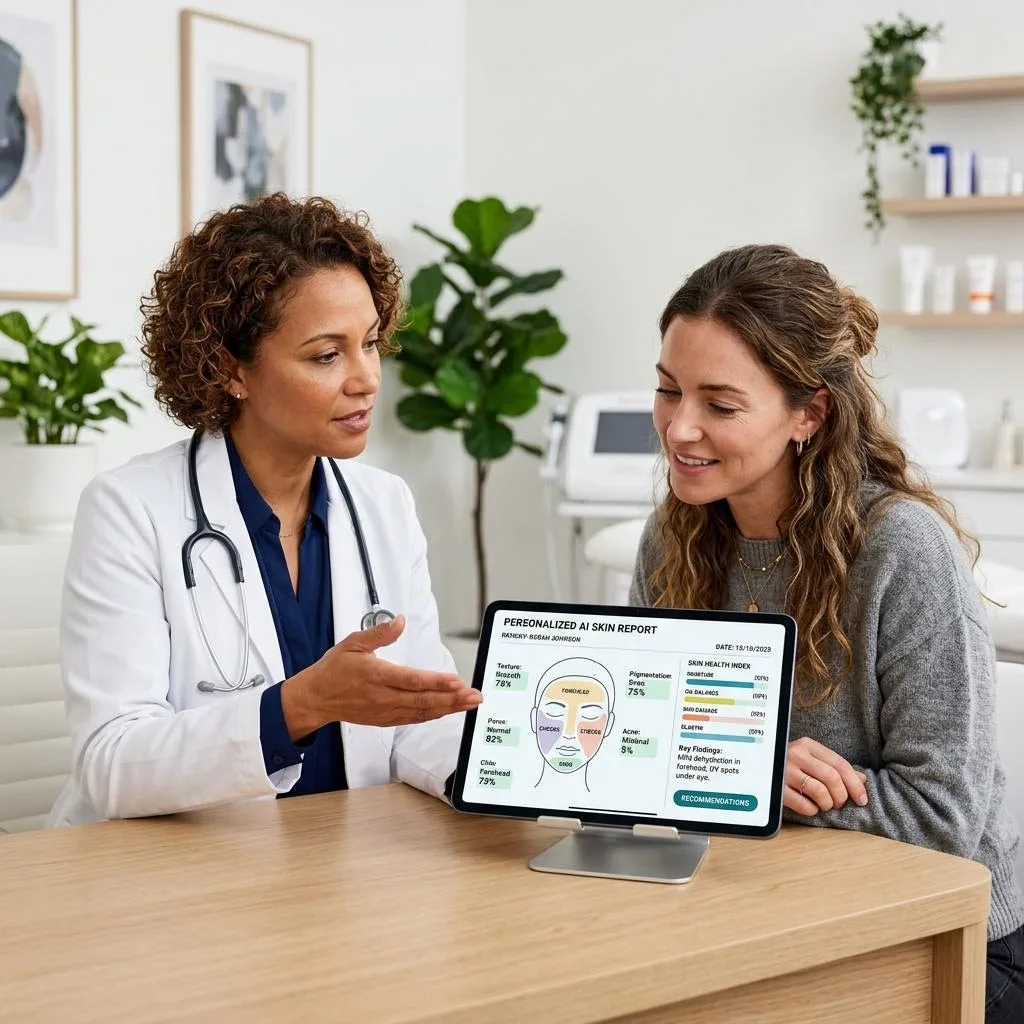
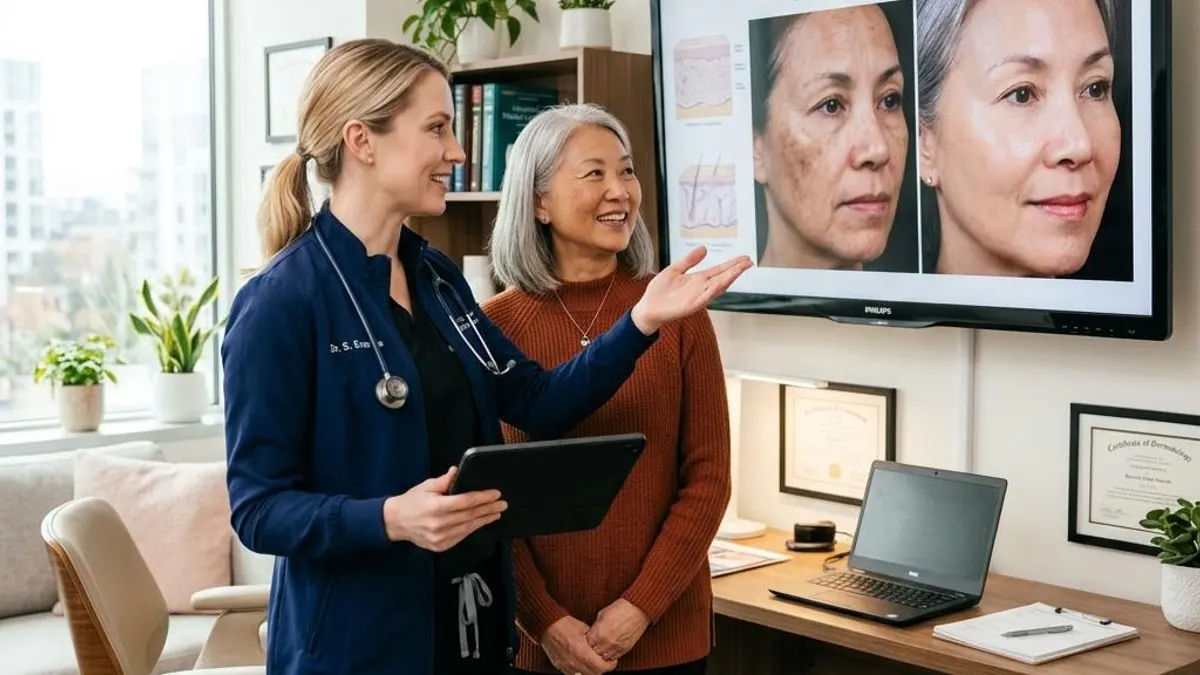
AI skin analysis replaces that dynamic with an objective scan result. Technologies such as ProSkinScan’s clinic analysis platform use facial landmark mapping across multiple zones — T-zone, U-zone, cheeks — to detect and score conditions like acne, dark spots, wrinkles, enlarged pores, and skin age estimation. The results are visual and specific. The client sees exactly what the practitioner sees, broken down into discrete concerns with measurable severity.
This is not a cosmetic upgrade to the consultation — it changes who is making the claim. The machine confirms the diagnosis before the practitioner makes any recommendation. By the time the practitioner speaks, the client has already acknowledged the problem exists.
2. It Creates a Data-Supported Treatment Rationale
A common consultation mistake is moving too quickly from diagnosis to recommendation. The practitioner identifies dehydration and pigmentation and immediately suggests a combination of vitamin C infusion and microneedling. The client hears: “You have problems, and here is what I’m selling you.”
AI analysis allows the practitioner to build a logical bridge. The scan result shows elevated melanin concentration in specific zones, reduced skin brightness in the cheek area, and visible fine-line texture scoring. Each condition maps directly to a corresponding treatment. The practitioner is no longer recommending — they are translating the data into a treatment plan.
Research from Ponce AI, which developed its platform with plastic surgeons trained on over 10,000 real-world cases, reports that 90 percent of patients who underwent AI facial analysis proceeded to purchase additional treatments during the same visit. The mechanism is not surprise or pressure — it is clarity. Patients could see what they had, understand what addressed it, and make an informed decision.
3. It Compresses the Time-to-Trust
Perfect Corp’s analysis of AI skin analysis in medspa software identifies trust as the primary conversion driver. When clients receive visual, data-backed skin reports, they are more likely to accept treatment plans precisely because the evidence exists independently of the practitioner’s opinion. The report exists. The scores exist. The recommendation follows logically.
This is particularly significant for first-time clients, who arrive with the highest scepticism. An AI scan conducted before the consultation — even as a pre-appointment digital experience sent via booking confirmation — primes the client to engage with the data rather than evaluating the practitioner’s judgment from a defensive posture.
Common Mistakes Clinics Make When Implementing AI Skin Analysis
Running the Scan After the Verbal Diagnosis
Some practitioners conduct their manual assessment first, then use the AI scan as a confirmation tool. This reverses the psychological sequence. If the client has already heard the practitioner’s opinion, the scan is perceived as evidence that was cherry-picked to support that opinion. Run the scan first, always.
Pro Tip
Pro Tip: Configure the scan output so each detected concern maps to a specific treatment option in your menu. A generic report produces generic outcomes; a mapped report produces booked procedures.
Using Generic Reports Without Clinic-Specific Treatment Mapping
Many AI tools produce reports that list skin concerns but do not connect them to specific treatments available at that clinic. A client reading “moderate hyperpigmentation score: 4.2/10” leaves with a number but no action. The scan output must be configured to map each detected concern to a specific treatment option with a named protocol and approximate price range.
Treating AI Analysis as a Marketing Feature Rather Than a Clinical Tool
Several clinics adopt AI skin analysis primarily because it looks impressive on social media. That is not wrong, but it is not conversion optimisation. The clinical workflow integration — how the scan is presented, when in the consultation it occurs, how the practitioner explains the findings — determines whether it converts.
Skipping Progress Tracking
Clinics that use AI analysis only for initial consultation miss half the conversion opportunity. Progress scans — comparing the client’s skin at 4 weeks, 8 weeks, and 3 months against their baseline — become the primary driver of repeat treatment bookings. A client who sees measurable improvement in their dark spot score is far more likely to book the next round than one who simply recalls feeling good after the last treatment.
A Smarter Conversion Strategy Using AI Skin Analysis
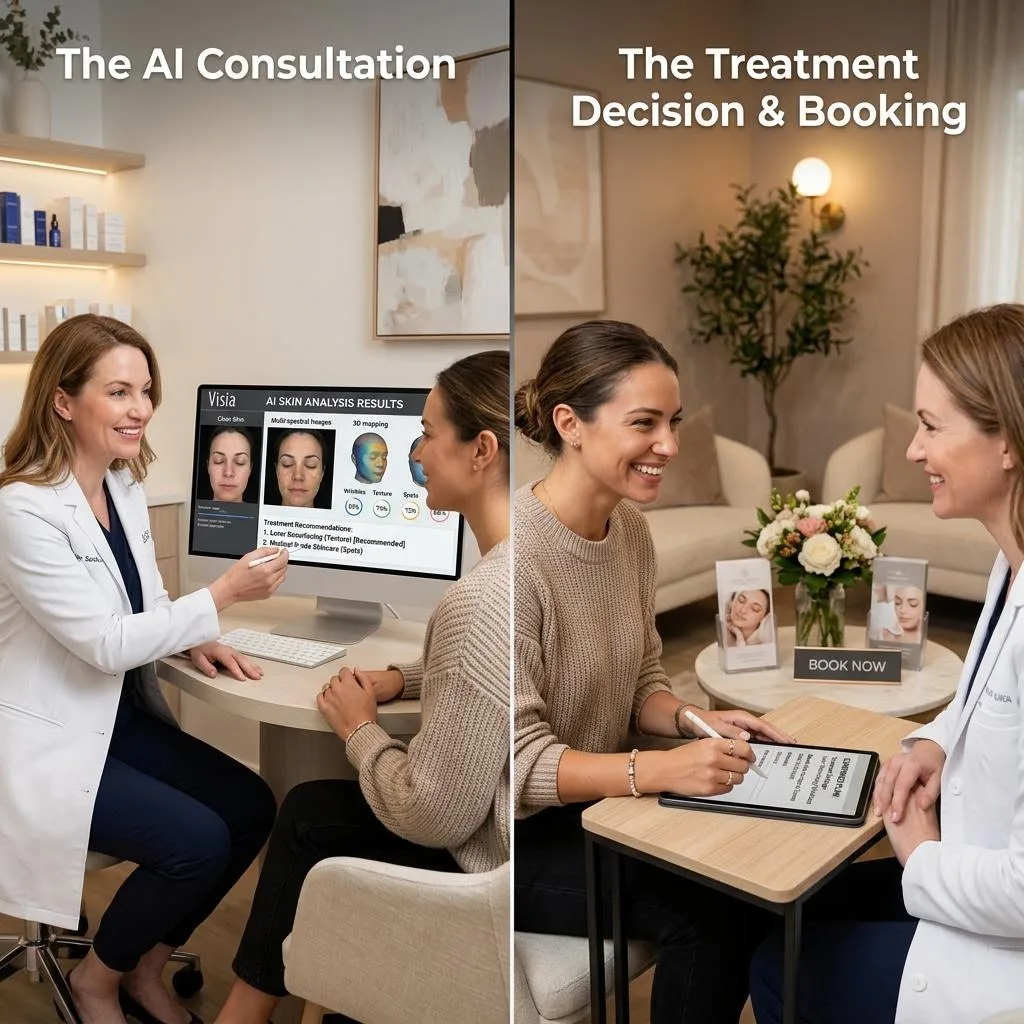
The clinics that consistently achieve consultation-to-treatment conversion rates above 75 percent use AI skin analysis as a structured clinical protocol, not an optional add-on. The sequence looks like this:
Before the appointment: Send a mobile-accessible AI skin scan link with the booking confirmation. The client completes a preliminary scan from home. The practitioner reviews results before the client arrives.
During consultation (first 5 minutes): Open the consultation with the client’s scan report visible to both parties. Walk through each flagged concern using the visual data. Ask the client whether these concerns align with what they have noticed themselves. (They almost always do.)
During consultation (middle phase): Present a tiered treatment plan that directly addresses the top two or three concerns identified in the scan. Price each tier. Show how each treatment targets specific scan findings rather than presenting a package.
During consultation (close): Invite the client to book one or two sessions to begin addressing their highest-priority concern. Offer to re-scan after the initial treatment phase to show measurable results.
This protocol does not require a practitioner to become a salesperson. It requires them to let the data create the treatment rationale and then present options clearly. The conversion happens because the logic is visible.
Pre-Appointment Scan
Sent with the booking confirmation
Open With the Report
Walk through flagged concerns together
Present Tiered Plan
Priced options tied to each finding
Book & Re-Scan
Confirm session, plan the next scan
Implementation Considerations
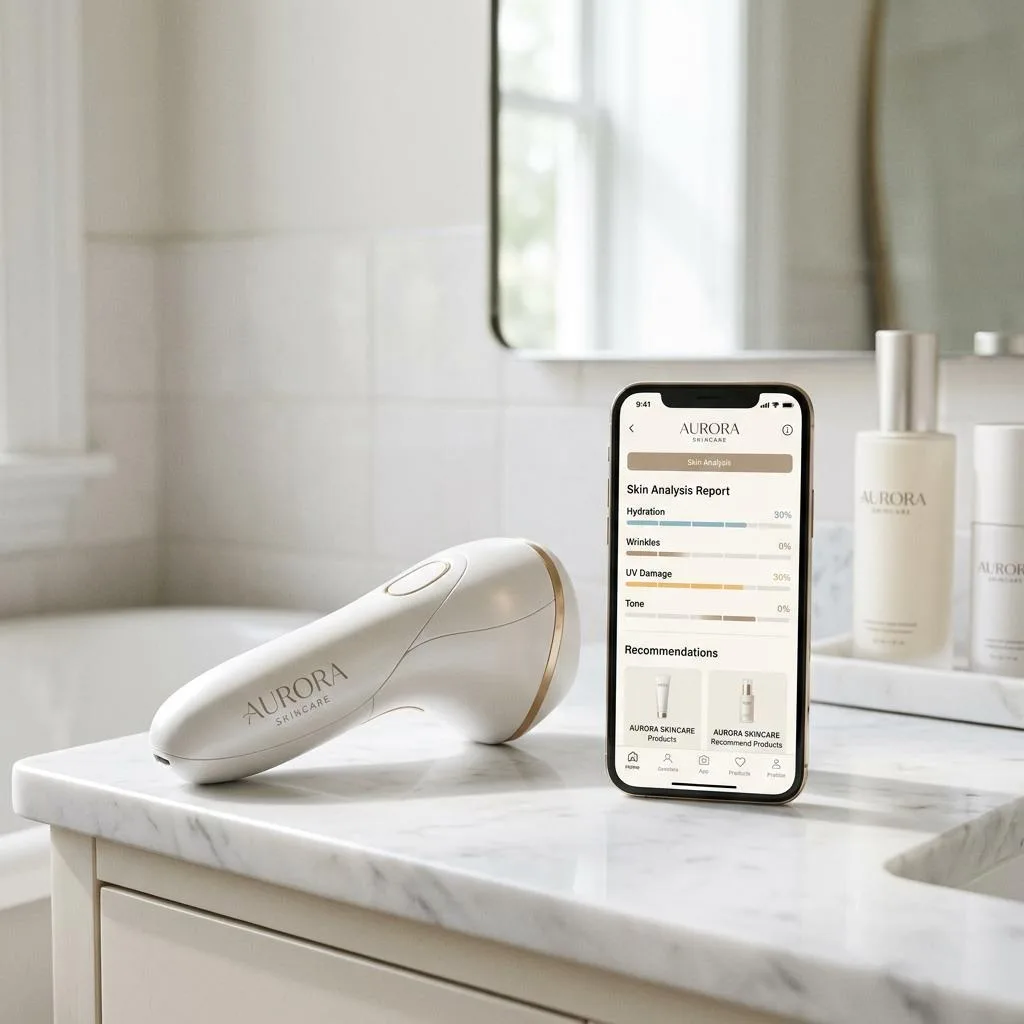
Hardware requirements: Most AI skin analysis platforms, including ProSkinScan, operate via standard smartphone or webcam captures. No dedicated dermatoscopy hardware is required.
Integration with booking and CRM systems: The scan workflow should connect to client records so that baseline results are automatically stored and available for comparison at follow-up appointments. Standalone scan results that live outside the client record create administrative friction.
Staff training time: The more significant training investment is teaching practitioners how to present scan results conversationally — translating numerical scores into plain-language findings without sounding clinical to the point of coldness.
Data privacy compliance: AI skin analysis involves biometric facial data. Clinic operators must ensure their chosen platform complies with relevant data protection requirements in their jurisdiction and that clients provide informed consent before scanning.
Buying and Evaluation Signals to Watch For
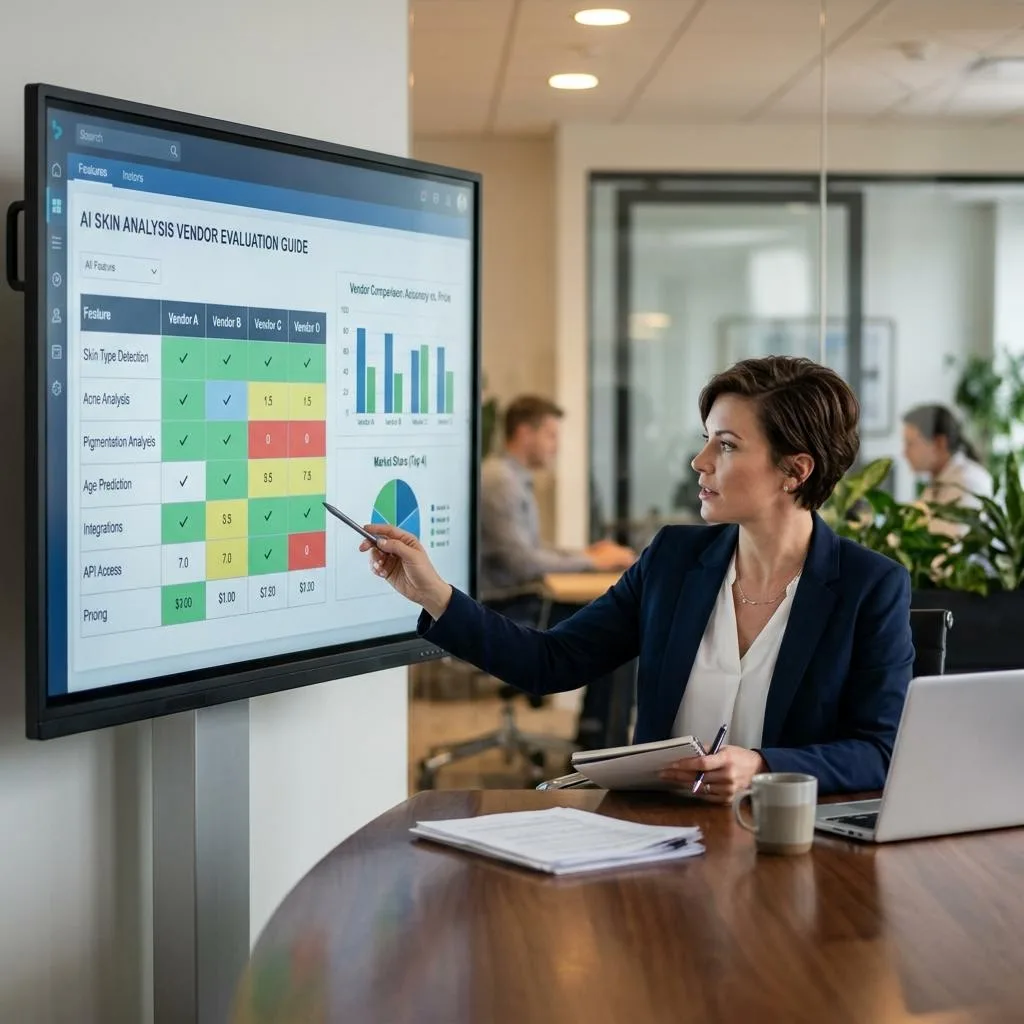
When evaluating AI skin analysis platforms for consultation conversion optimisation, prioritise:
- Zone-specific analysis — a platform that reports skin conditions by facial zone allows practitioners to have more targeted conversations about specific treatment sites
- Practitioner-facing dashboard — the output must be designed for clinical use; practitioners need sortable, comparable client data to track outcomes at scale
- Treatment recommendation mapping — the platform should allow the clinic to configure which treatments correspond to which detected conditions
- Progress comparison functionality — before-and-after scan comparison is the retention tool that drives repeat bookings
- Demo availability — for clinic-specific AI skin analysis, explore the ProSkinScan clinic demo to evaluate the consultation workflow directly

Important
Important: AI analysis supports the decision — clinical judgment remains entirely with the practitioner. Never let a scan report override or stand in for professional assessment.
Frequently Asked Questions
Q: What is a good consultation-to-treatment conversion rate for aesthetic clinics?
Industry benchmarks vary, but clinics with structured consultation protocols typically convert between 60–75 percent of first-time consultations into booked treatments. High-performing clinics using objective diagnostic tools report conversion rates above 80 percent for returning clients.
Q: Does AI skin analysis replace the practitioner’s clinical judgment?
No. AI skin analysis provides objective baseline data and visual documentation of skin conditions. Clinical judgment — evaluating which treatments are appropriate given a client’s health history, medication use, and aesthetic goals — remains entirely with the practitioner. AI analysis supports and contextualises that judgment.
Q: How much time does an AI skin scan add to a consultation?
A typical AI skin scan takes 30–90 seconds to complete. If a pre-appointment digital scan is sent to the client before they arrive, zero time is added to the in-clinic consultation. The practitioner simply opens the pre-existing report rather than running a new scan.
Q: Can AI skin analysis help with treatment upselling?
Yes, though the framing matters. When scan results show multiple skin concerns, the data creates a natural basis for discussing a comprehensive treatment approach. Clients who understand their baseline are more receptive to discussions about combination protocols because the logic is visible rather than being perceived as up-selling.
Q: What skin conditions can AI analysis detect for consultation purposes?
Leading platforms detect conditions including acne and acne-prone areas, enlarged pores, blackheads, dark spots and hyperpigmentation, fine lines and wrinkles, skin texture irregularities, dullness and brightness loss, skin type classification, and estimated skin age. ProSkinScan’s clinic platform covers this full range, including zone-specific mapping across T-zone, U-zone, and cheeks.
Q: Do clients respond well to AI analysis during consultations?
Generally, yes. Clients typically find AI skin analysis more reassuring than they find it clinical or impersonal. The visual objectivity of a scan result helps them feel that the practitioner’s recommendation is based on their specific situation rather than a generic sales approach. According to CBA Medicine’s review of AI tools for aesthetic practitioners, AI diagnostics enhance informed consent by providing data-driven visualisations that support the clinical conversation.
Q: How is progress tracking implemented practically?
At each follow-up appointment, the practitioner runs a new AI scan under the same conditions as the baseline scan (consistent lighting, same device if possible). The platform compares the new scan against the stored baseline and generates a change report. This report becomes the basis for the review consultation and the next treatment booking conversation.
Where to Start
Consultation-to-treatment conversion is a measurable outcome. The clinics that treat it as a system rather than a practitioner skill issue are the ones that improve it consistently. AI skin analysis provides the objective foundation that transforms consultations from personal presentations into evidence-based clinical conversations.
If you operate an aesthetic clinic or medspa and want to evaluate how AI skin analysis fits your consultation workflow, the ProSkinScan clinic demo provides a working example of the full scan-to-recommendation process. You can evaluate the output quality, the zone-specific reporting, and the treatment mapping interface before making any platform decision.