AI skin analysis software for aesthetic clinics is a platform that uses machine learning and facial image processing to automatically detect skin conditions and generate personalized treatment recommendations — replacing or augmenting manual practitioner-led skin assessments.
There is a recurring problem in aesthetics that almost every clinic operator recognises but rarely talks about openly: the consultation bottleneck. A client arrives, the practitioner spends fifteen to twenty minutes conducting a manual skin assessment, the client receives a verbal summary they half-remember, and the recommended treatment protocol is rarely reviewed again until the next booking — if the client returns at all. Multiplied across a full appointment schedule, this pattern quietly suppresses both treatment conversion rates and long-term client retention.
AI skin analysis software for aesthetic clinics exists specifically to close this gap. Done well, it transforms the consultation from a manual, practitioner-dependent exercise into a repeatable, documented, data-driven clinical event. Done poorly — and there is quite a lot of poor implementation in the market — it adds friction, erodes trust, and produces generic output that a client could have found on a consumer skincare app.
This guide is written for clinic directors, medspa operators, and aesthetic practice managers who are evaluating AI skin analysis tools seriously, not for the first time, and want a clear framework for decision-making.
Why Manual Skin Consultations Are Quietly Limiting Your Clinic’s Revenue
Manual skin assessment is not inaccurate — an experienced aesthetician can identify key concerns reliably. The problem is that it is slow, subjective, undocumented, and not reproducible at scale. When a client books a second appointment with a different practitioner, continuity breaks. When you are trying to upsell a treatment series, a verbal assessment from six weeks ago is a weak foundation.
The economic impact is measurable. According to Coherent Market Insights, clinics adopting AI-based digital skin assessment tools see treatment conversion rate increases of 12–25% and consultation time reductions of 20–40%. Those are not marginal gains in a business where appointment capacity is fixed and each client interaction carries significant acquisition cost.
The AI skin analysis market itself reflects this shift in demand — valued at USD 2.13 billion in 2026 and projected to reach USD 6.30 billion by 2033 at a CAGR of 16.8% (Coherent Market Insights). The majority of that growth is happening at the clinic and medspa level.
20–40%
Faster consultation time
12–25%
Treatment conversion increase
85–94%
Diagnostic accuracy range
Key Takeaway
Key Takeaway: Clinics adopting AI-based digital skin assessment tools report treatment conversion increases of 12–25% and consultation time reductions of 20–40% — the two metrics that most directly move revenue per treatment chair.
What AI Skin Analysis Software Actually Does in a Clinical Setting
It helps to be precise about functionality, because marketing language in this space tends toward vagueness.
Important
Important: The commercial figures cited throughout this guide are vendor-reported rather than independently validated. Treat them as directional benchmarks to test in your own clinic — not guaranteed outcomes.
Core Diagnostic Capabilities
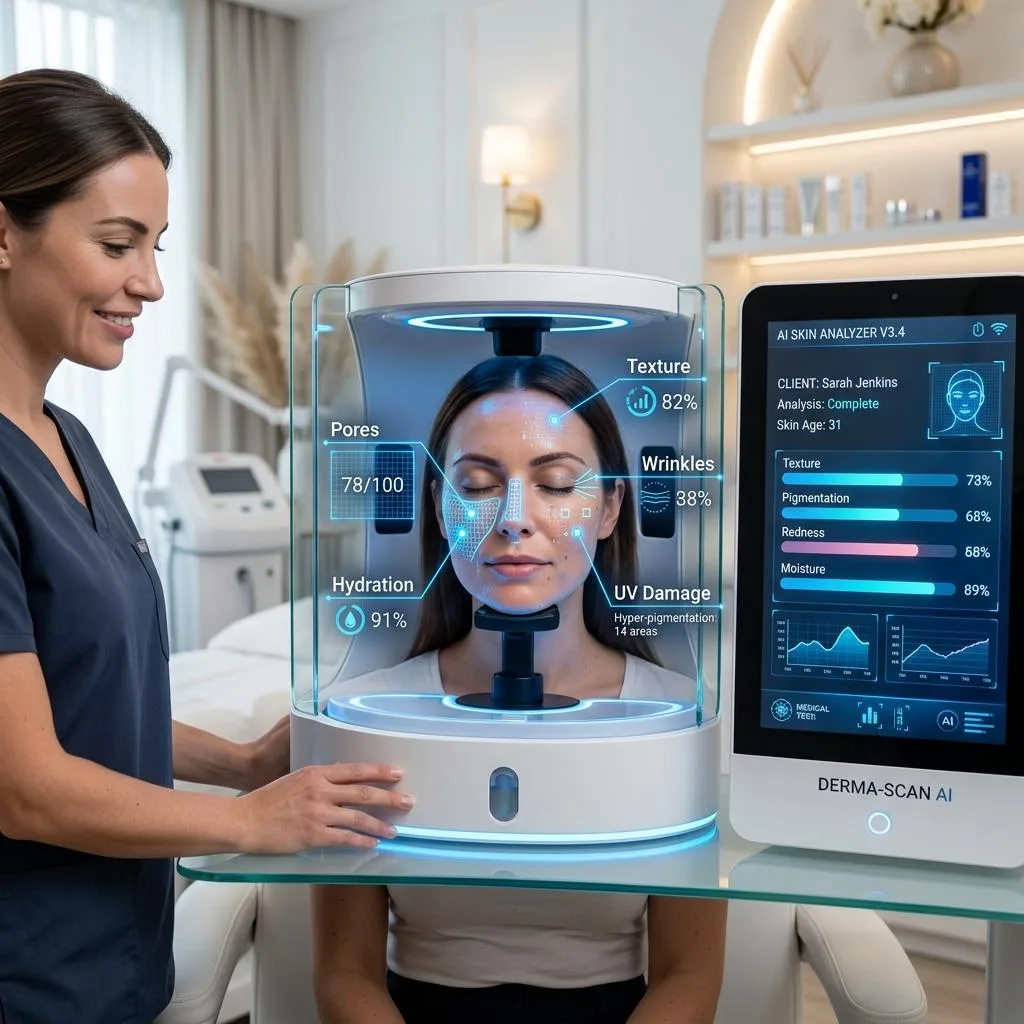
A capable AI skin analysis platform processes a facial photograph — typically taken via smartphone or webcam — and returns a structured report across multiple skin parameters. Platforms like ProSkinScan use facial landmark detection (mapping hundreds of distinct facial reference points) and zone-based analysis to assess the T-zone, U-zone, and cheek areas independently. Detection capabilities include acne and active breakouts, enlarged pores, blackheads, dark spots and hyperpigmentation, dullness and skin brightness, acne scarring, fine lines and wrinkles, and skin age estimation.
Leading tools benchmark diagnostic accuracy in the 85–94% range, with melanoma-specific detection sensitivity exceeding 90% in clinical-grade platforms (Coherent Market Insights). Vendor materials describe tools that assess 15+ skin-health metrics with claimed accuracy up to 98% (vendor-reported, as cited by CBA Medicine). Note: SkinGPT is specifically Haut.AI’s generative-simulation product, while the “15+ metrics / up to 98%” figures belong to Haut.AI’s skin-analysis models — and all are vendor-reported rather than independently validated.
Capture Selfie
Client photo via smartphone or webcam
Multi-Zone AI Analysis
T-zone, U-zone and cheeks scored independently
Treatment Protocol Match
Findings mapped to the clinic's own menu
Progress Tracking
Before/after comparison each session
From Report to Treatment Recommendation
The diagnostic layer is table stakes. What differentiates clinic-grade software from consumer apps is the ability to map skin findings directly to clinic treatment protocols. A client presenting with active acne, enlarged pores, and early-stage pigmentation should not receive the same three-treatment recommendation as a client with dehydration, fine lines, and dullness. AI skin analysis software bridges this gap by converting objective skin data into protocol-matched recommendations — chemical peels, microneedling, laser therapy, or anti-ageing procedures — aligned to what the clinic actually offers (Perfect Corp).
Progress Tracking Over Time
The third functional layer, and often the most commercially valuable, is longitudinal tracking. Clients who can visually compare their skin condition before and after a treatment series are significantly more likely to book the next phase. A before/after scan dashboard removes the subjectivity from the client’s perception of progress.
Common Mistakes Clinics Make When Adopting AI Skin Analysis Tools
Mistake 1: Selecting a Consumer-Facing App Instead of a Clinic Platform
Consumer skincare apps are built for broad, general audiences and return generic recommendations regardless of what a specific clinic offers. A clinic-grade AI skin analysis solution must be configurable to the clinic’s own treatment menu and product lines.
Mistake 2: Treating the Scan as a Standalone Event
The most common operational failure is deploying AI skin analysis as a novelty — the client does a scan, receives a printout, and the data is never referenced again. High-performing clinics build the scan into the consultation workflow at every visit.
Mistake 3: Ignoring Lighting and Capture Standardisation
AI skin analysis accuracy is directly dependent on image quality. Clinics that allow clients to scan under inconsistent lighting conditions produce unreliable baseline data. The QDerma clinic demo by ProSkinScan illustrates correct capture guidance.
Mistake 4: Skipping Staff Training on Result Interpretation
AI-generated reports require clinical context. A practitioner who cannot explain to a client why their skin age estimate is higher than their chronological age will erode rather than build trust.
A Smarter Implementation Strategy for Aesthetic Clinics
Phase 1: Pre-Appointment Digital Skin Diagnostics
Send the scan link as part of the booking confirmation. The client uploads a selfie from home, the AI generates the report, and the practitioner reviews findings before the appointment begins. This compresses in-clinic assessment time and allows the practitioner to arrive at the consultation already equipped with objective data. PerfectCorp’s research documents this workflow as a driver of faster consultations and stronger treatment conversion.
Pro Tip
Pro Tip: During the consultation’s first five minutes, open with the client’s scan report visible to both parties. Seeing their own skin mapped to your proposed protocol builds trust far faster than a verbal summary alone.
Phase 2: Consultation-Stage Visual Communication
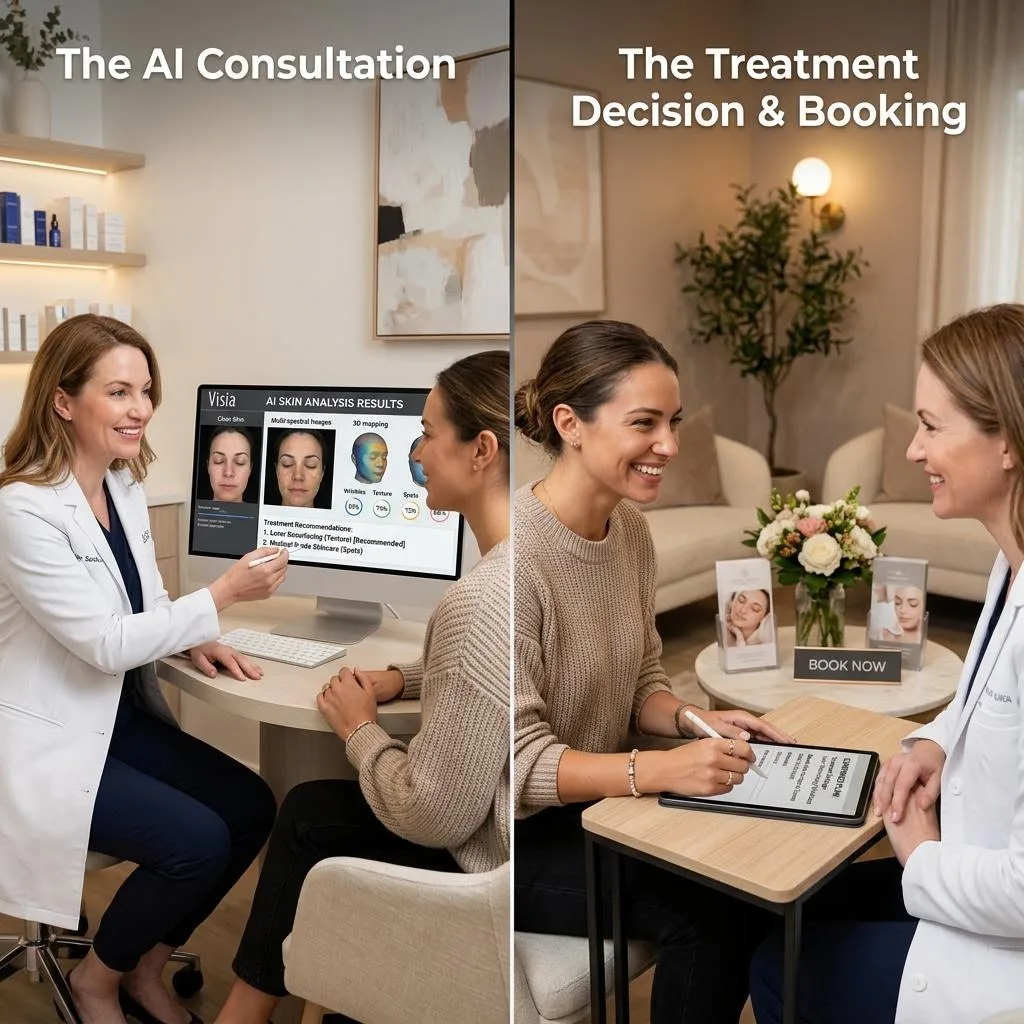
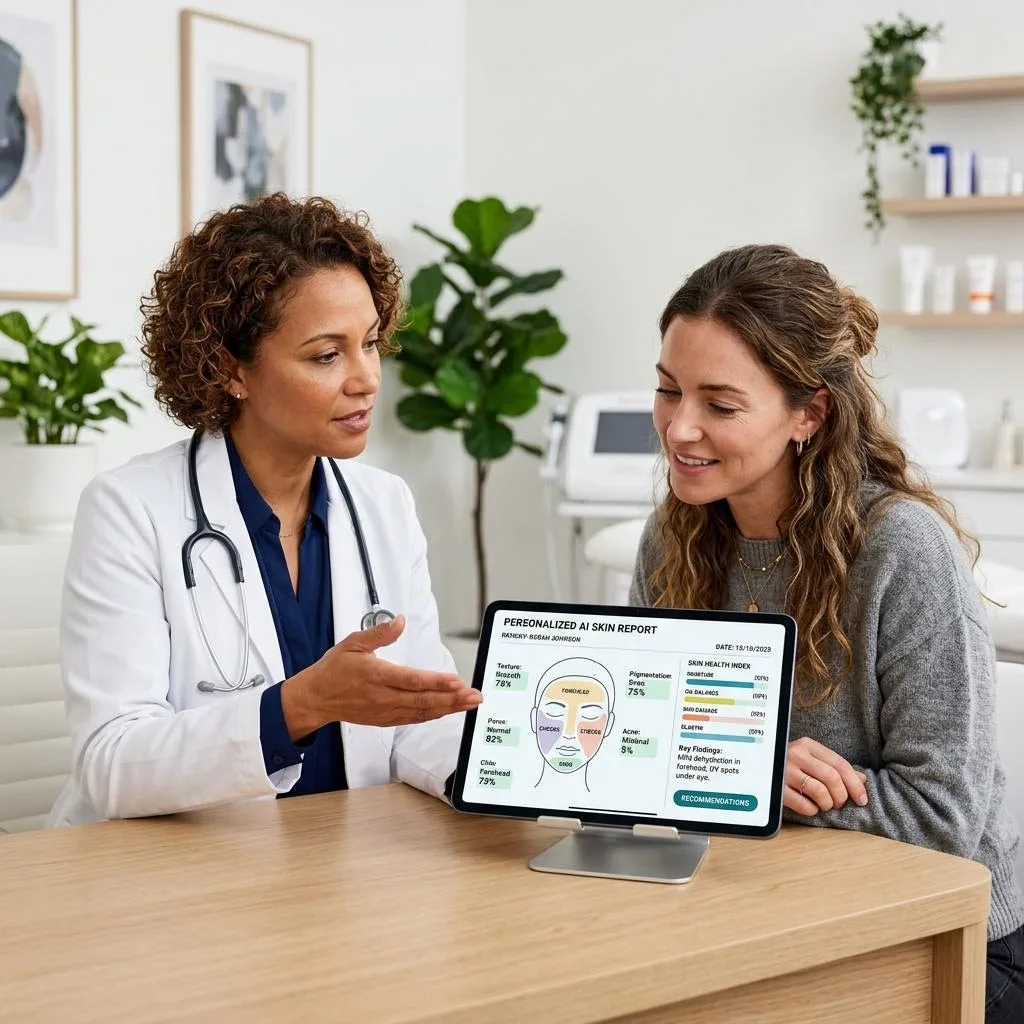
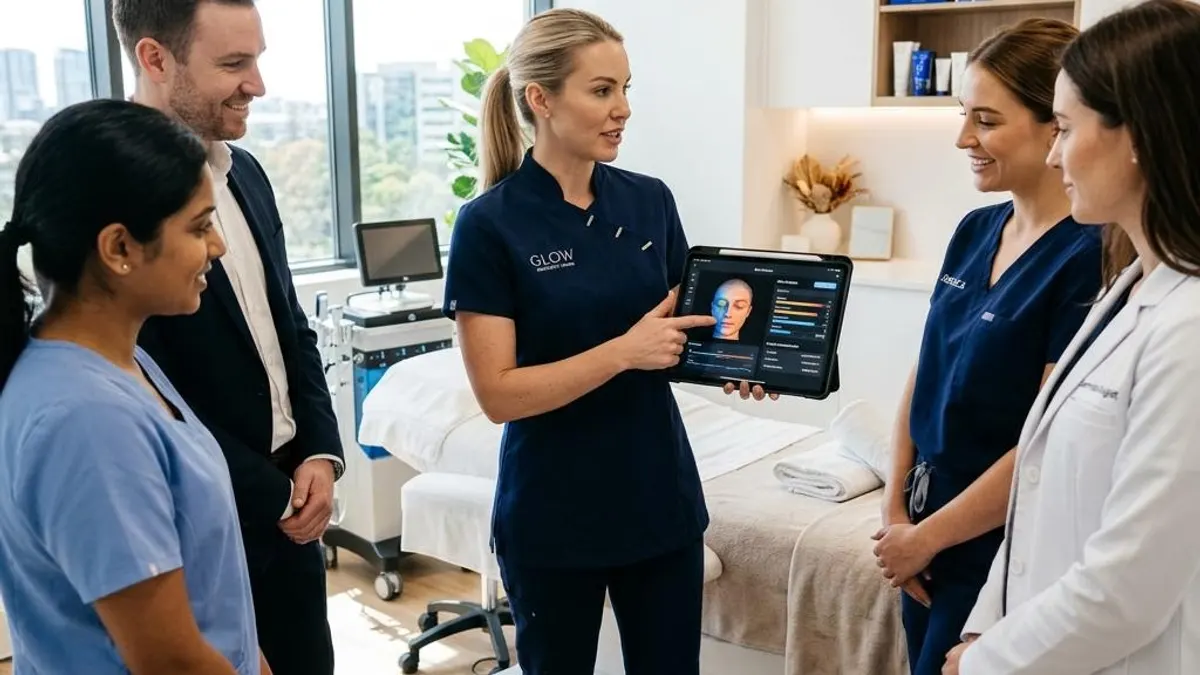
Present the scan report on a screen during the consultation. Clients who can see the data — visualised skin zones, detected concerns, severity indicators — engage differently with treatment recommendations.
Phase 3: Treatment Series Commitment with Progress Milestones
Build scan milestones into multi-session treatment packages. Rescan at session 3 and session 6. Share the comparison. This approach directly addresses the retention problem because it converts abstract clinical progress into documented, visual, client-owned evidence.
What to Evaluate When Selecting AI Skin Analysis Software
Diagnostic breadth and accuracy — How many skin parameters does the platform assess? Is diagnostic accuracy independently validated?
Clinic configurability — Can the treatment recommendations be mapped to your specific service menu?
Integration architecture — Does the platform connect to your booking system, EMR, or CRM?
Data handling and privacy — Facial images are sensitive biometric data. Where is data processed and stored?
Deployment speed — Building AI skin diagnostics from scratch can take years of development (Perfect Corp). Software-as-a-service platforms and API-based deployments like ProSkinScan significantly compress time to launch.
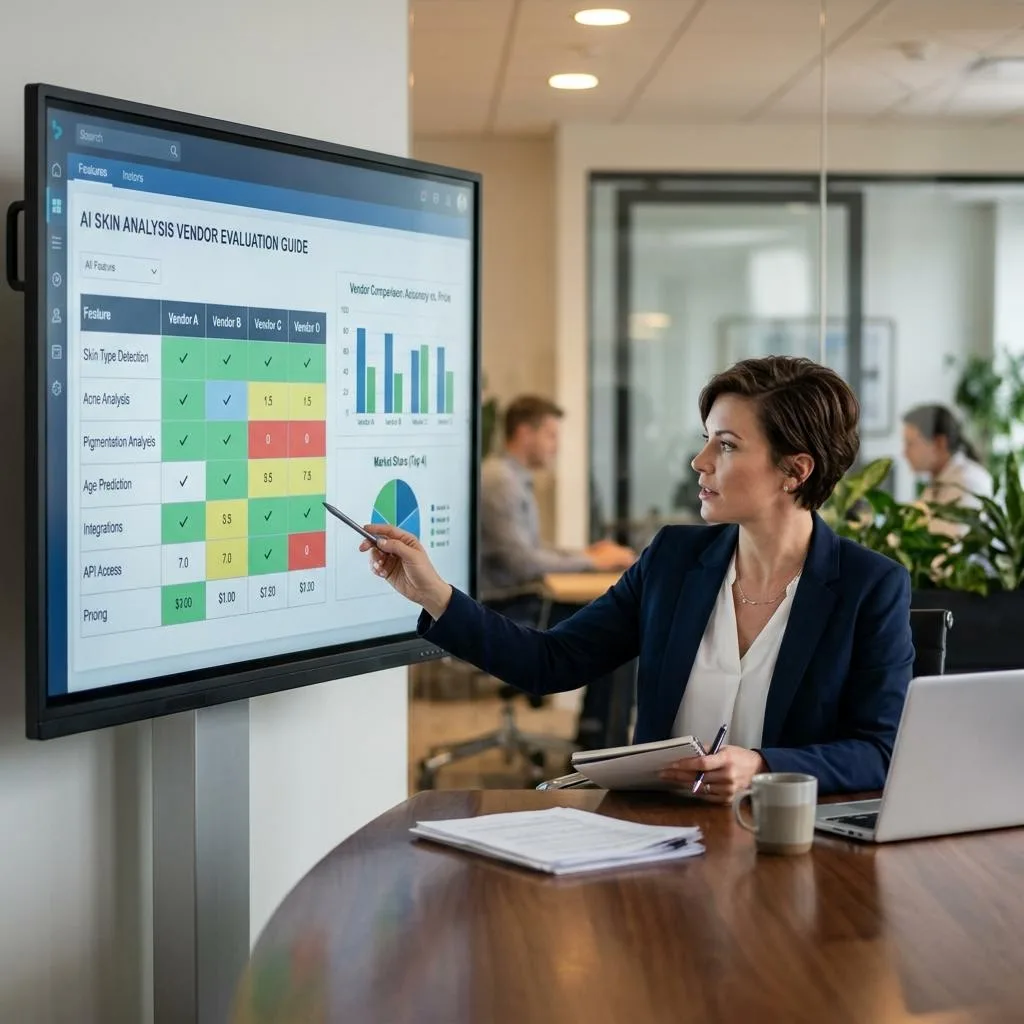
Clinic Software Evaluation: Feature Comparison Matrix
| Feature | Must-Have | Nice-to-Have | Not Needed for Most |
|---|---|---|---|
| Zone-specific facial analysis (T/U/cheeks) | ✅ | — | — |
| 15+ skin conditions detected | ✅ | — | — |
| Treatment recommendation mapping | ✅ | — | — |
| Progress / before-after comparison | ✅ | — | — |
| Web-based (no hardware required) | ✅ | — | — |
| Client data storage + history | ✅ | — | — |
| White-label branding | — | ✅ | — |
| CRM / booking system integration | — | ✅ | — |
| Hair & scalp analysis | — | ✅ | — |
| On-premise / offline processing | — | — | ✅ |
| Custom ML model training | — | — | ✅ |
Buying and Evaluation Signals: How to Know You Are Ready
You are ready to evaluate AI skin analysis software seriously when your clinic exhibits at least three of the following conditions:
- Consultation time regularly exceeds 15 minutes for new client skin assessments
- Practitioner-to-practitioner handoffs produce inconsistent client records
- Treatment package rebooking rates fall below your retention target
- Clients frequently undervalue their progress between sessions because there is no documented baseline
- Your current consultation process does not generate exportable client skin data
- A competing clinic in your market has begun offering digital skin diagnostics
FAQ: AI Skin Analysis Software for Aesthetic Clinics
Q1: How accurate is AI skin analysis compared to a trained aesthetician?
Leading AI skin analysis tools achieve diagnostic accuracy in the 85–94% range for common skin concerns (Coherent Market Insights). For quantifiable, reproducible assessment of parameters like pore size, pigmentation, and texture — the AI is frequently more consistent than human evaluation, because it eliminates practitioner variability.
Q2: Can AI skin analysis software be integrated into an existing clinic booking system?
Yes. Modern platforms offer REST API, mobile SDK, and web SDK integration paths (Perfect Corp). Cloud-based platforms — which account for 66.7% of the current AI skin analysis software market (Coherent Market Insights) — minimise infrastructure requirements on the clinic side.
Q3: Will clients feel uncomfortable being scanned by AI?
Client acceptance is generally high when the scan is framed correctly — as a clinical tool that enables more personalised, evidence-based care — rather than as a gimmick.
Q4: What skin conditions can AI analysis reliably detect?
Current platforms commonly assess acne and breakouts, enlarged pores, blackheads, hyperpigmentation and dark spots, dullness and skin brightness, acne scarring, fine lines, wrinkles, and estimated skin age. Platforms like ProSkinScan perform zone-specific analysis across the T-zone, U-zone, and cheek areas for more granular findings.
Q5: How does AI skin analysis affect treatment conversion rates?
Clinics using AI-based digital skin assessment tools report treatment conversion rate increases of 12–25% (Coherent Market Insights). The mechanism: data-backed recommendations carry more persuasive weight than verbal assessments.
Q6: Is AI skin analysis suitable for all skin tones?
Quality platforms are trained on large global datasets that include diverse skin tones, age groups, and lighting conditions (Perfect Corp).
Q7: How quickly can a clinic deploy AI skin analysis software?
SaaS and API-based platforms can go live within days to weeks. Most clinic deployments focus on the pre-appointment scan workflow first, then extend to in-consultation display and progress tracking in a second phase.
Ready to See It in Practice?
If your clinic is ready to move beyond manual consultations and into data-driven skin diagnostics, the fastest way to evaluate fit is to see the technology live. The QDerma clinic demo shows how AI skin and hair analysis works in a real aesthetic clinic context.
For a broader overview of ProSkinScan’s AI skin analysis platform for clinics and brands, visit proskinscan.com.