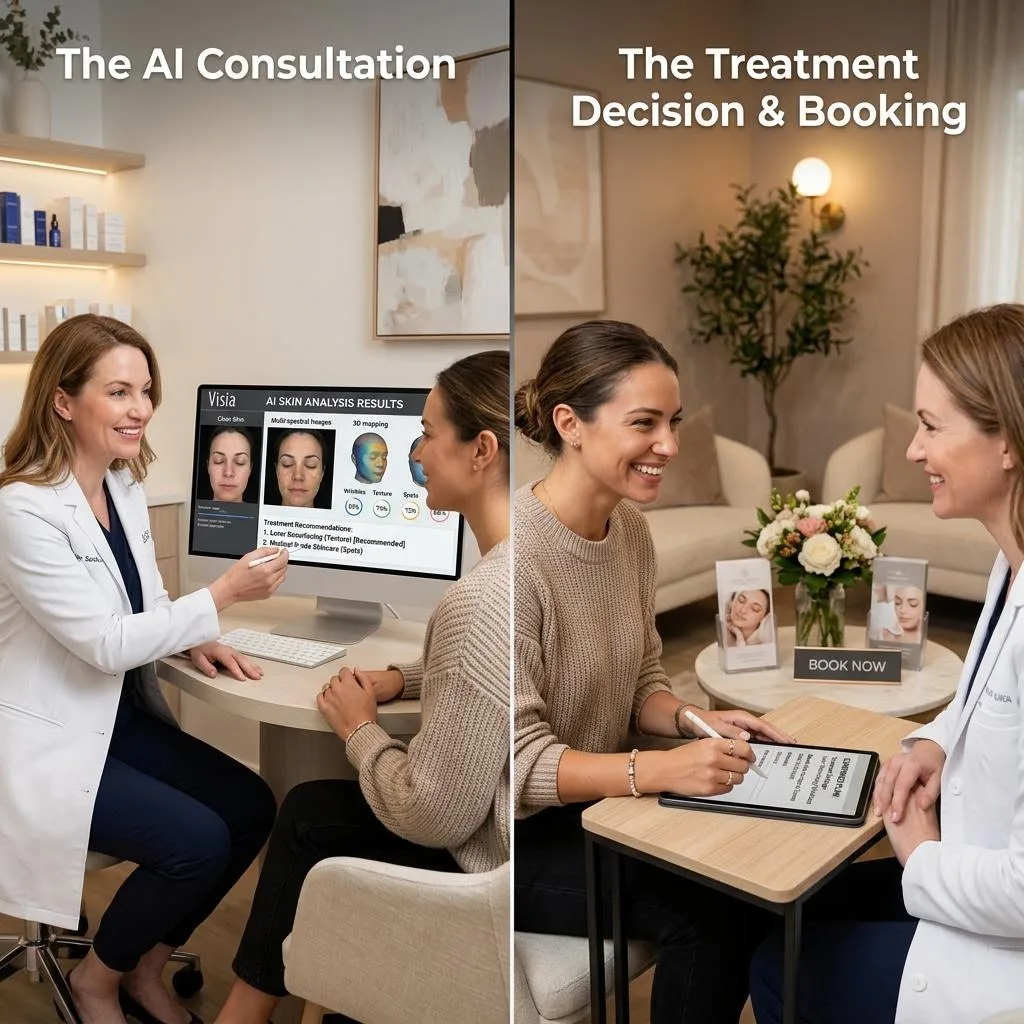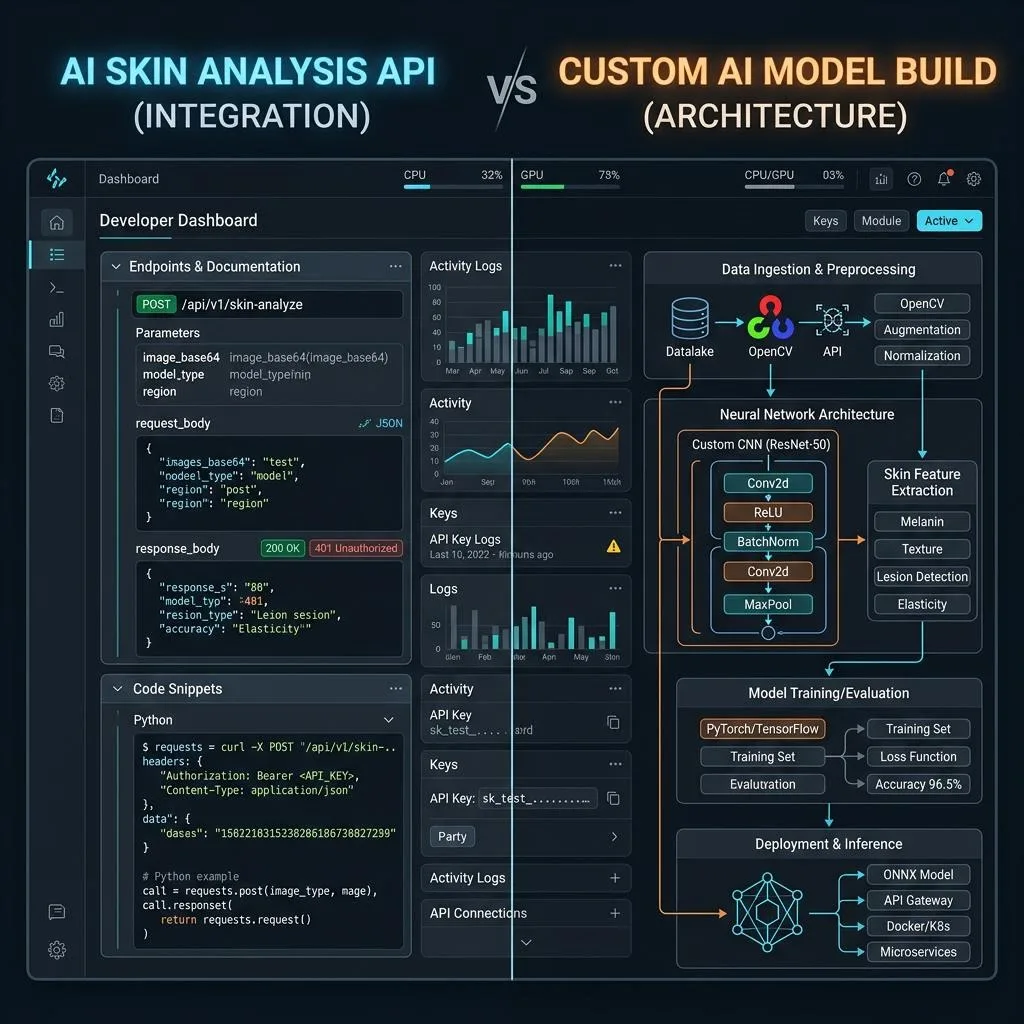
A skin analysis API is a cloud-based machine learning service that analyzes facial photos to detect skin conditions such as acne, wrinkles, pores, hyperpigmentation, and skin texture. It returns structured diagnostic data via REST or SDK integration, enabling beauty businesses to add AI-powered skin diagnostics to their apps, websites, or platforms without custom AI development.
Most teams reach the build-vs-buy decision in the worst possible way: after spending six months and a significant engineering budget on a custom skin analysis model that still isn’t production-ready. A regional skincare distributor recently went this route — hired two ML engineers, licensed a dataset from a dermatology research group, and spent eleven months iterating. The result was a model that performed reasonably on studio-quality photos but degraded sharply under real-world mobile conditions: varied lighting, off-angle selfies, and skin tones underrepresented in training data. By month twelve, they were evaluating third-party skin analysis APIs anyway.
This article is for operators who want to make this decision correctly the first time: skincare brand leaders, beauty SaaS product managers, agency technology directors, and consultants advising clients on AI skin diagnostic infrastructure.
What a Skin Analysis API Actually Does
A skin analysis API is a hosted machine learning service that accepts an image — typically a facial photo — and returns structured diagnostic data about detected skin conditions. Common outputs include acne presence and density, pore visibility, wrinkle depth estimation, hyperpigmentation markers, skin texture scores, dullness indices, and estimated skin age.
Integration works through standard channels: REST API endpoints, mobile SDKs for iOS and Android, and web SDKs for browser-based implementations. Platforms like ProSkinScan use technologies such as MediaPipe Face Mesh to detect 468 facial landmarks, running separate zonal analyses across the T-zone, U-zone, and cheeks. Detection methods include blob detection for acne, morphological analysis for enlarged pores, adaptive thresholding for blackheads, LAB colour space analysis for dark spots, and edge detection for wrinkle mapping.
The diagnostic output isn’t a single score. It is a multi-dimensional skin condition profile that a downstream system can use to drive product recommendations, consultation prep, treatment matching, or personalised content.
The Real Cost of Building Custom
The appeal of a custom build is understandable: full ownership, no API dependency, deeper customisation, and the perception of a higher defensible moat. The actual cost structure looks very different in practice.
Data Requirements
Training a skin analysis model from scratch requires hundreds of thousands of annotated facial images spanning diverse skin tones, age ranges, lighting conditions, and camera hardware. Dermatologically validated annotation — the kind that produces clinically reliable outputs — requires dermatologist review of training labels. Licensing a sufficiently large dataset runs from tens of thousands to over a hundred thousand dollars depending on diversity requirements and annotation depth.
Engineering and Infrastructure
Computer vision for skin analysis isn’t a standard classification task. It requires multi-label detection (a single face may have acne, hyperpigmentation, and enlarged pores simultaneously), facial landmark-based zonal segmentation, and normalisation pipelines to handle real-world image variability. A production-ready system also needs image quality validation — poor-quality inputs should be rejected before inference, not after.
Building this correctly typically requires at minimum a senior ML engineer, a computer vision specialist, and a backend engineer to manage the serving infrastructure. According to data shared by Skinive, a comparable API integration can be achieved in approximately 100 lines of code and a single day of development work.
Maintenance and Drift
A custom model is a liability as well as an asset. Model drift — where real-world input distributions shift away from training data over time — requires ongoing monitoring. New devices, updated camera software, and evolving user demographics all affect performance. API providers absorb this maintenance burden as part of their service; custom builds add it to the engineering roadmap permanently.
Timeline Reality
Perfect Corp’s industry analysis puts custom development timelines at years, not months. The comparison to API integration — which their documentation describes as days using developer-friendly REST endpoints and SDKs — represents a timeline gap of an order of magnitude for most teams.
Key Takeaway
Key Takeaway: The build-vs-buy gap is an order of magnitude: an API integration ships in 1–4 weeks, while a serious custom model typically runs six to eighteen-plus months and $150K–$500K+ — before ongoing maintenance and model-drift costs are added. For most teams, the default answer is API.
Where a Skin Analysis API Wins Decisively
Time to Market
A beauty SaaS platform that wants to offer skin diagnostics as a feature can ship with an API integration in a matter of days. A custom build ships, at best, in six to twelve months — and that estimate assumes the team has the right expertise from day one.
Dataset Quality at Scale
Providers like Skinive report their models have processed over five million screenings. That volume of real-world inference creates feedback loops that improve accuracy in ways a single company’s training set cannot replicate. Training on large, globally diverse datasets also produces better generalisation across skin tones — a failure mode that custom builds with limited training budgets hit reliably.
Integration Flexibility
Modern skin analysis APIs are designed for the full spectrum of integration contexts: patient portals, e-commerce product pages, mobile consultation apps, booking system pre-screens, and in-store kiosk interfaces. ProSkinScan supports both website embedding and mobile application integration. The diagnostic output feeds directly into whatever recommendation or consultation layer the operator has built.
Measurable Business Outcomes
Operators using established AI skin analysis platforms report consistent commercial lift. Skinive reports (vendor-stated) a 50% increase in customer-loyalty metrics and a 20% revenue increase for integrated platforms. Haut.AI’s own materials report an average increase of roughly 34% in order (cart) value among its customers after adopting AI-based skin analysis — a vendor-reported figure referring to order value, not total sales. These are outcomes built on production-tested infrastructure, not experimental models.
1–4 weeks
API integration vs. 6–18+ months custom build
$150K–$500K+
Typical upfront cost of a custom AI build
34%
Average order value lift after API adoption (Haut.AI)
API vs Custom Build: Side-by-Side Comparison
| Criterion | Ready-Made Skin Analysis API | Custom AI Build |
|---|---|---|
| Time to market | 1–4 weeks | 6–18+ months |
| Upfront cost | Low (usage-based) | $150k–$500k+ |
| Training data | Millions of images (vendor-provided) | Limited to your own dataset |
| Ongoing maintenance | Vendor-managed | Full in-house team required |
| Skin tone accuracy | Broad (diverse global datasets) | Depends on your data coverage |
| Customisation | Configured, not architected | Full control |
| Scalability | Automatic | Manual infrastructure work |
| Compliance handling | Vendor’s DPA covers you | Your full responsibility |
| Best for | Brands, clinics, SaaS, agencies | Unique IP, 10M+ scans/month |
Important
Important: A custom build is only justifiable under narrow conditions: proprietary diagnostic IP, tens of millions of scans per month, or hard regulatory constraints. If none of those apply, a custom model is a costly liability, not an asset.
When a Custom Build Is Actually Justified
Custom builds are not always wrong. There are specific scenarios where the investment has a clear case:
Proprietary diagnostic differentiation. If your brand’s core competitive claim is a novel skin analysis method — one based on a unique combination of biometric signals, custom skin condition definitions, or a patented assessment framework — a custom build is the only way to realise that differentiation. An API gives you industry-standard diagnostics; it does not give you a diagnostic method no one else can replicate.
Vertical integration at scale. Enterprises processing tens of millions of analyses per month may reach a cost crossover point where API pricing exceeds the amortised cost of custom infrastructure. This is a calculation that needs real volume numbers, not projected ones.
Regulatory environment constraints. In some healthcare-adjacent markets, using third-party ML services raises data residency or regulatory questions that make an on-premise model operationally necessary regardless of cost.
For the vast majority of skincare brands, beauty SaaS platforms, distributors, and agencies evaluating this decision, none of these conditions apply. The default answer is API integration.
Common Mistakes Operators Make
Mistaking model sophistication for business value. Teams sometimes pursue custom builds because they want a technically impressive system, not because the business actually requires capabilities beyond what an API provides.
Underestimating annotation costs. Many custom build proposals calculate compute costs and engineering salaries but leave dataset acquisition and annotation as a vague line item. In practice, high-quality dermatologically annotated skin image datasets are expensive.
Ignoring image quality variability. A model that performs well in a lab environment can degrade dramatically on real mobile camera images. Skinive’s API includes an image quality check that rejects low-quality inputs before inference — and critically, does not charge for rejected images. A custom build must implement this independently.
Treating the API as a black box. Operators who integrate a skin analysis API without understanding the output schema, confidence intervals, and detection thresholds build downstream recommendation logic on shaky assumptions.
Locking into a single integration point. A skin analysis API should feed multiple downstream systems — recommendation engines, consultation prep tools, CRM data layers, progress tracking dashboards. Treating it as a feature rather than infrastructure limits its return on investment.
Pro Tip
Pro Tip: Start with an API and validate demand before ever commissioning a custom build. Production-tested providers report consistent commercial lift — for example, an average increase of roughly 34% in order (cart) value — so let real metrics drive the eventual build decision.
Smarter Implementation Strategy
The operators who extract the most value from a skin analysis API treat the integration as a data layer, not a feature toggle. A phased approach works well for most teams:
Integrate
Surface diagnostics with basic recommendations
Personalise
Train recommendation rules on your catalogue
Track
Compare scans over time for retention

ProSkinScan supports this architecture — the platform’s AI skin diagnostic output is designed to integrate with brand-specific product catalogues, enabling personalised recommendations without requiring custom ML infrastructure.
Evaluation Signals: What to Look for in a Skin Analysis API Provider
- Skin condition coverage breadth. A production-ready API should cover acne, pore analysis, hyperpigmentation, texture scoring, dullness, scar detection, and estimated skin age as a minimum.
- Zone-level analysis. Aggregated face scores are less actionable than T-zone, U-zone, and cheek-level breakdowns.
- Image quality gatekeeping. Does the API validate image quality before inference? Does it charge for rejected images?
- Integration documentation quality. A provider’s documentation quality is a reliable proxy for their engineering culture.
- Data privacy and residency. Where is inference performed? Are images stored?
- Skin tone diversity in training data. Ask directly. Providers who cannot answer clearly should be tested rigorously before production deployment.
Buying Considerations: API vs Custom Build
| Decision Criterion | API Integration | Custom Build |
|---|---|---|
| Time to production | Days to weeks | 6–18+ months |
| Upfront cost | Low (API fees from ~€400/month) | High (engineering, data, infrastructure) |
| Ongoing maintenance | Provider-managed | Internal engineering resource |
| Skin tone generalisation | Provider-tested at scale | Dependent on training data investment |
| Customisation ceiling | API output schema | Full (with corresponding cost) |
| Image quality handling | Typically included | Must be built separately |
| Regulatory flexibility | Depends on provider | Fully controlled |
Frequently Asked Questions
Q: How accurate are skin analysis APIs compared to custom models?
Established API providers have processed millions of real-world screenings, producing generalisation that custom builds cannot match without equivalent data investment. For brands without large proprietary dermatological datasets, API providers will typically outperform custom models on real-world mobile inputs.
Q: Can a skin analysis API integrate with an existing CRM or recommendation engine?
Yes. REST API outputs return structured JSON data consumable by any downstream system. The standard pattern is: API output → business logic layer → recommendation engine or CRM event. ProSkinScan is specifically designed to connect diagnostic outputs to brand-specific product catalogues.
Q: How long does API integration typically take?
Basic API integration can be completed in one to three days for a standard development team. Building a polished user-facing diagnostic experience — including the photo capture interface, results display, and recommendation layer — typically takes two to four weeks.
Q: Do skin analysis APIs support all skin tones reliably?
This varies by provider. Request benchmark data across the Fitzpatrick scale before committing. Providers with large global user bases — particularly significant Asia-Pacific, South Asian, and African demographics — tend to have better skin tone generalisation.
Q: Is a skin analysis API suitable for a B2B SaaS platform reselling to brands?
Yes. API and white-label SDK integrations are standard for SaaS platforms that want to offer skin diagnostics as a feature. Ensure your contract with the API provider explicitly permits sublicensing or white-label use.
Q: What is the difference between a skin analysis API and a skin analysis SDK?
An API is a server-side integration: your application sends an image to the provider’s servers and receives a diagnostic result. An SDK runs inference on-device or in-browser without a server round-trip, offering lower latency but more maintenance overhead. Most providers offer both.
Ready to see how AI skin analysis performs in a real product environment? Explore the ProSkinScan app demo or visit proskinscan.com to evaluate the platform for your brand or SaaS product.