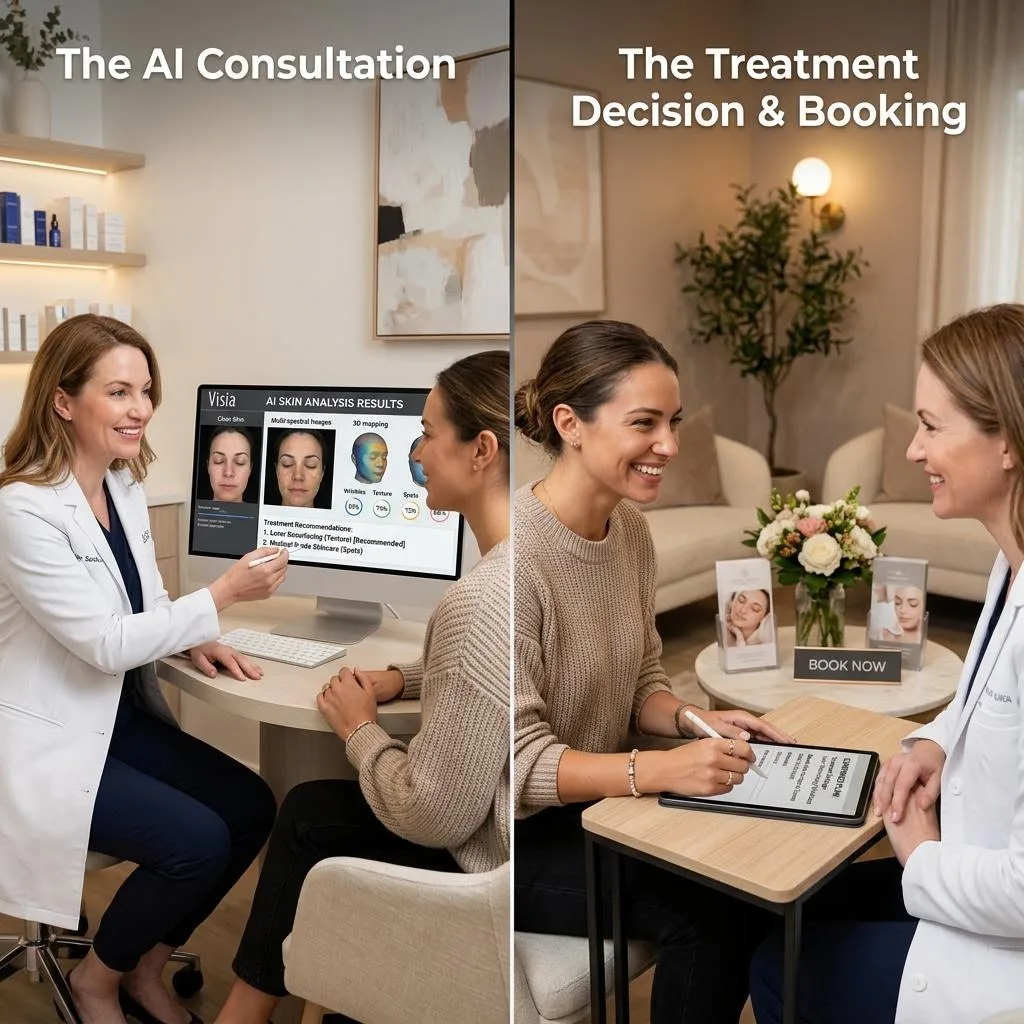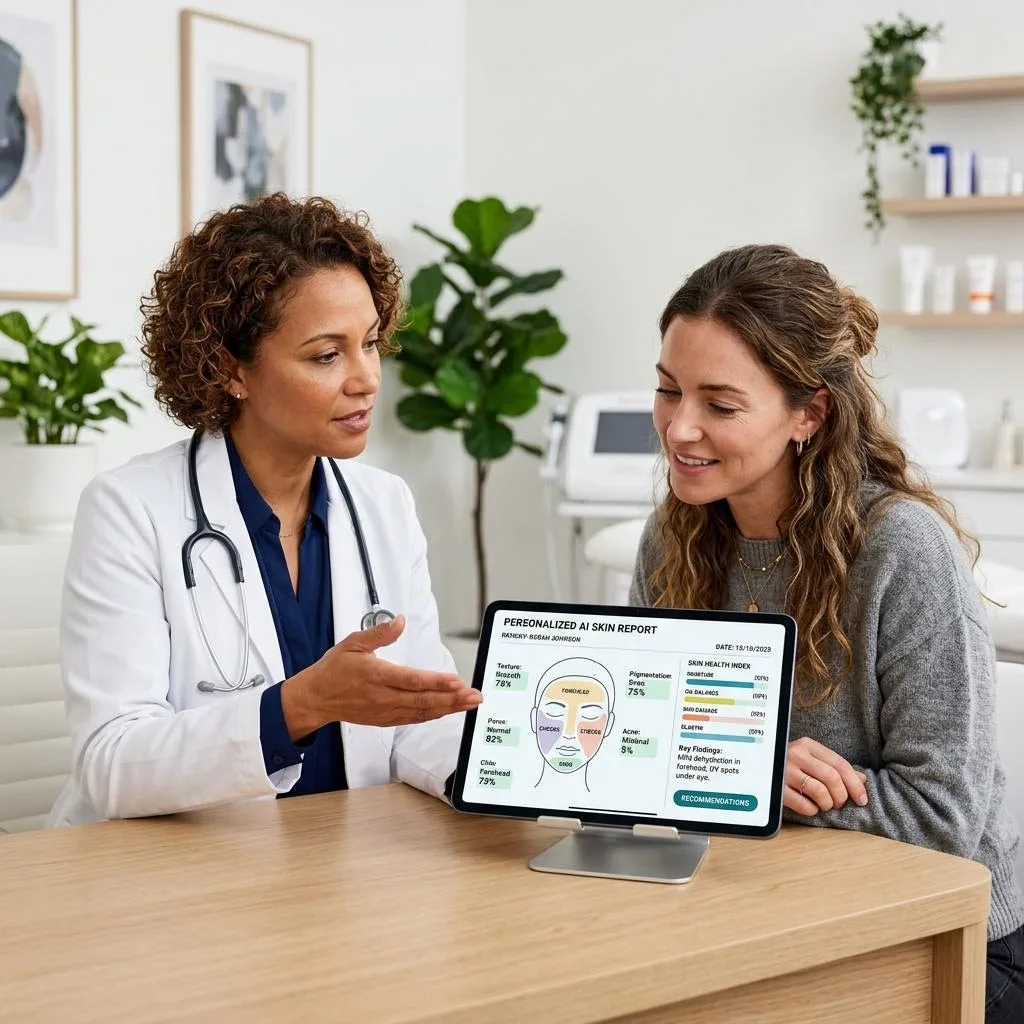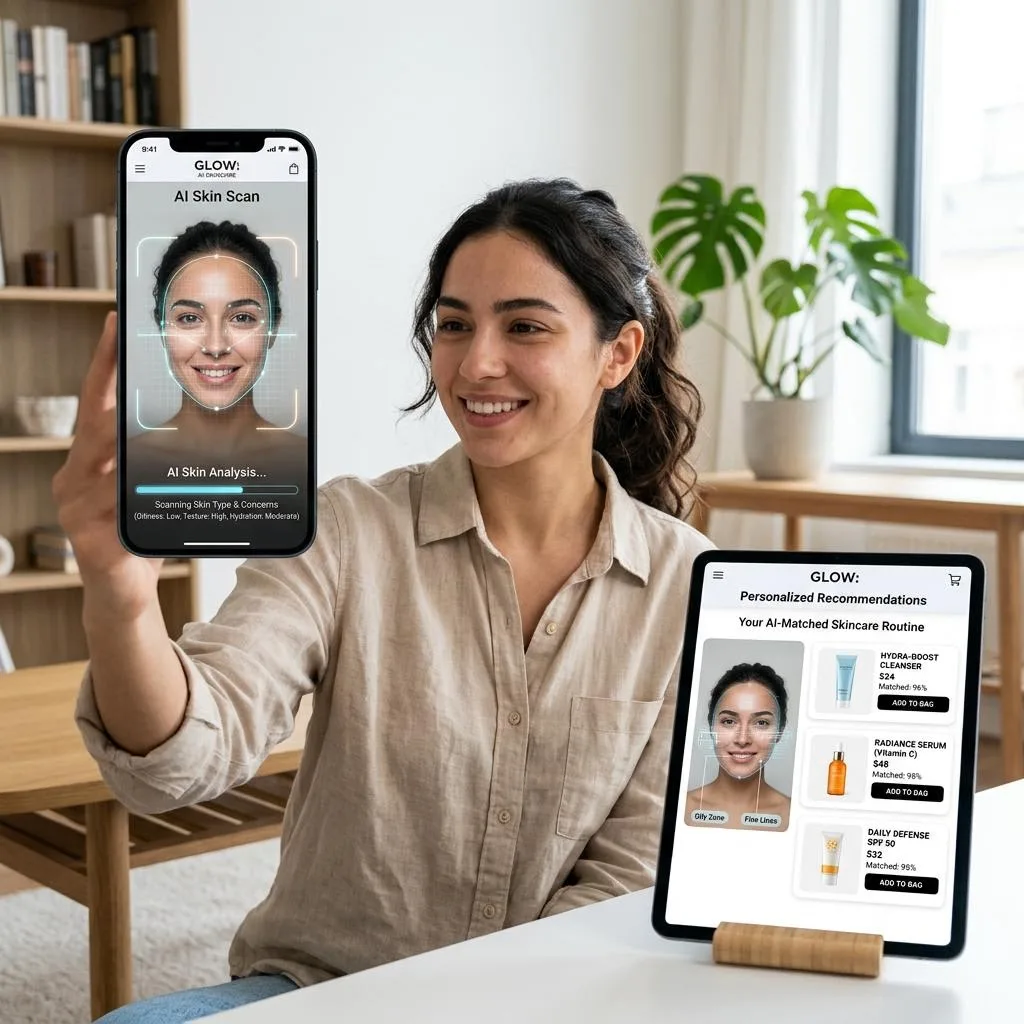
Skincare product recommendation software is a tool that matches consumers to skincare products based on their skin conditions. AI-powered versions use facial image analysis to detect conditions objectively and map them to a brand’s product catalog — producing more accurate recommendations than quiz-based tools that rely on self-reported skin type.
Here is a pattern that shows up consistently across skincare e-commerce: a brand invests in a quiz funnel — ten questions about skin type, concerns, and age — and markets it as “personalized skincare.” Conversion from the quiz is measured, optimised, and reported upward. What does not get measured is return rates, repeat purchase depth, and the segment of customers who chose the wrong product despite completing the quiz.
The problem with quiz-based recommendation is self-reported data: consumers are not reliable reporters of their own skin conditions. Studies of self-assessed versus clinically assessed skin type show significant mismatches, particularly for combination and sensitive skin classifications. A customer who believes they have dry skin when the underlying issue is barrier impairment will follow a recommendation toward heavy emollients when barrier repair actives are what they need.
Skincare product recommendation software powered by AI skin analysis replaces self-report with objective diagnostic data — and that difference has measurable commercial consequences.
What Separates AI-Powered Recommendation from Quiz Personalization
The functional distinction comes down to the input data.
Quiz-based systems build a recommendation on a customer’s answers to categorical questions. The output reflects what the customer believes about their skin. AI skin analysis builds a recommendation on computer vision assessment of the customer’s actual facial image — detecting acne presence and density, pore visibility, texture uniformity, wrinkle depth, hyperpigmentation zones, dullness, and estimated skin age across facial zones.
Revieve’s platform describes this architecture directly: algorithms match results from selfie skin diagnostics and user data to the partner’s specific product inventory, replacing traditional pre-defined recommendation rules with machine-learning-driven matching. The output is not a generic “combination skin” label with attached SKUs — it is a condition-specific product match from the brand’s actual catalogue.
ProSkinScan uses MediaPipe Face Mesh with 468 facial landmarks for this diagnostic layer, running zone-level analysis across the T-zone, U-zone, and cheeks separately. Detection methods include blob detection for acne, adaptive thresholding for blackheads, LAB colour space analysis for dark spots, and edge detection for wrinkles. The resulting skin condition profile — not a quiz score — drives product matching.
Key Takeaway
Key Takeaway: Recommendation quality begins with diagnosis, not quizzes — consumers are unreliable reporters of their own skin. Objective AI analysis is the difference that shows up as conversion, loyalty, and repeat purchase.
The Business Case: Why Diagnostic-Driven Recommendations Convert Better
Conversion rate. A diagnostic-driven recommendation gives the customer a transparent rationale: the system shows what it detected and explains the product connection. That credibility is structurally different from “customers with your skin type also bought” logic. Revieve reports increased conversion rates, basket sizes, and engagement as direct outcomes of diagnostic-foundation matching.
Return rate reduction. Incorrect recommendations are a leading driver of skincare returns. GlamAR data highlights return and refund reduction as a measurable outcome for Shopify brands using AI recommendation. When the recommendation is grounded in objective analysis rather than self-assessed skin type, the product is more likely to address the customer’s actual condition.
Customer retention. Skinive’s developer platform reports (vendor-stated) a 50% increase in loyalty metrics for integrated platforms. Progress tracking — letting customers compare analyses over time — creates a longitudinal data relationship tied to the brand’s ecosystem, a switching cost no transactional recommendation can replicate.
Average order value. A skin analysis flagging active acne, early hyperpigmentation, and texture irregularity simultaneously produces a recommendation spanning cleanser, treatment, and SPF — not a single moisturizer. Revieve describes routine recommendation as a core output: fully optimised regimens from the partner’s catalogue.
50%
Increase in customer-loyalty metrics (Skinive, vendor-stated)
3–5×
Revenue from a routine buyer vs. single-product buyer
8–12 wks
Recommended interval for re-analysis prompts
How AI Skincare Product Recommendation Software Works
1. Image capture. The customer takes a facial photo via webcam or smartphone camera, or uploads an existing photo. Quality checks validate the image before analysis proceeds. ProSkinScan’s app handles this with clear pre-scan guidance: clean face, bright lighting, direct camera angle, full face visible.
2. Skin analysis. Computer vision processes the image through a multi-label detection pipeline. Multiple conditions are assessed simultaneously across facial zones. The output is a structured condition profile — not a classification label but a multi-dimensional diagnostic map.
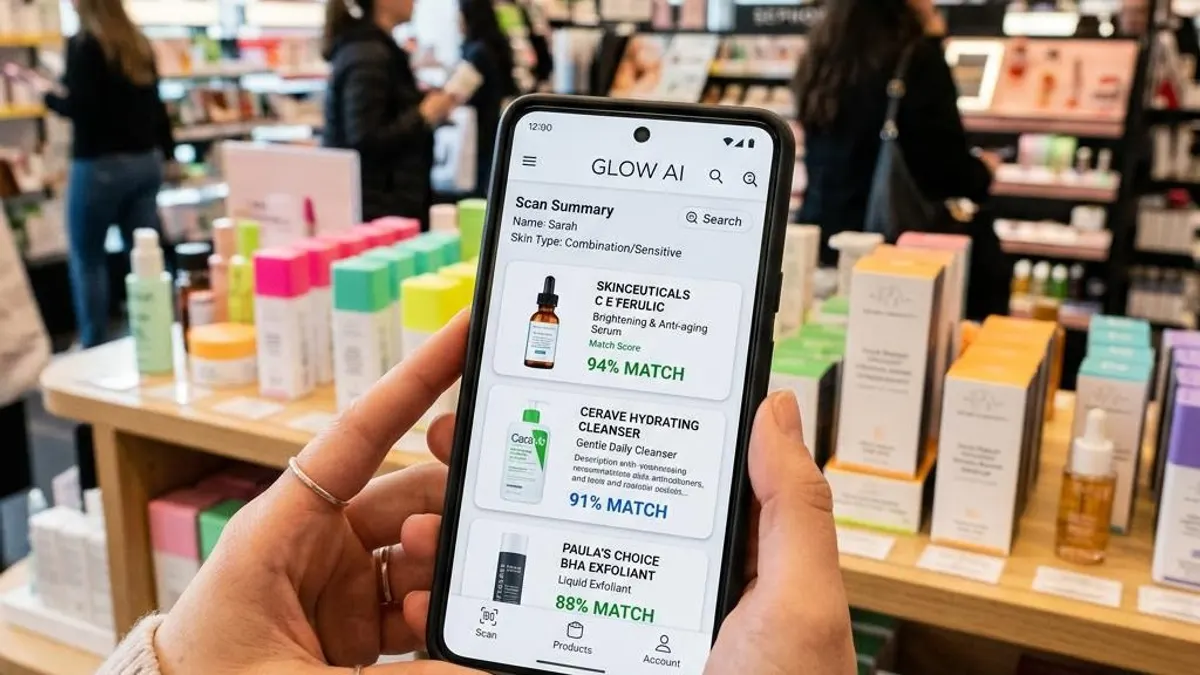
3. Catalogue matching. The condition profile is mapped to the brand’s product inventory. This is where recommendation software differs from raw diagnostic APIs: the matching logic accounts for product formulation, ingredient activity, SKU availability, pricing tier filters, and promotional overlays. Revieve includes customisation filters for price group and ingredients alongside product reviews, videos, and promotional integration.
4. Recommendation delivery. The customer receives an ordered recommendation — individual products, a routine sequence, or both — with rationale connecting the detected condition to the suggested product. This transparency layer builds recommendation credibility.
5. Progress tracking (optional but high-value). Customers who complete a second analysis weeks or months later generate a comparative record. This creates both a retention mechanic and a product efficacy signal — data that informs future recommendations and catalogue strategy.
Capture
Guided selfie or webcam photo
Analyze
Multi-label detection across zones
Match Catalogue
Condition profile mapped to SKUs
Recommend
Routine delivered with rationale
Implementation Models: How Brands and Operators Deploy This
Direct brand integration. A DTC or multi-SKU brand embeds recommendation software into their e-commerce property — a “Find My Routine” page, product pages, or post-purchase advisor. Major brands including Sephora, Olay, L’Oréal Paris, Pond’s, and Garnier have built branded versions of this workflow according to GlamAR’s market overview. For emerging brands, platforms like ProSkinScan deliver the same diagnostic capability with catalogue-specific matching without enterprise-scale investment.
Distributor and multi-brand retail. The recommendation must work across a curated multi-brand selection, requiring more sophisticated catalogue management — ingredient mapping, formulation comparisons, cross-brand routine logic. The diagnostic layer is the same; the downstream engine is more complex.
Manufacturer applications. For manufacturers, aggregate diagnostic data from consumer-facing analyses reveals which skin conditions dominate a target geography or demographic — intelligence that informs formulation priorities, product development roadmaps, and distributor conversations.
Important
Important: A recommendation engine covering only 30% of a brand’s SKUs will consistently miss the right match — no matter how accurate the AI. Catalogue coverage must be broad enough to map detected concerns to a real product customers can buy.
Common Mistakes Brands Make with Skincare Recommendation Software
Treating the tool as a one-time feature launch. The value compounds as more customers complete analyses and catalogue matching logic is refined.
Deploying without full catalogue integration. A recommendation engine covering 30% of a brand’s SKUs will consistently miss the right match. Include new launches, limited editions, and bundled offerings.
Not measuring recommendation-specific metrics. Standard analytics don’t isolate the recommendation engine’s contribution. Track conversion rate by recommendation path vs. unassisted browse, AOV for analysis completers vs. non-completers, and return rate by recommendation source.
Omitting the recommendation rationale. Showing only product tiles without the condition-to-product explanation strips the recommendation of its credibility advantage over generic bestseller logic.
Skipping image quality controls. Low-quality inputs produce unreliable diagnostics. Skinive’s API implements image quality checks before inference; platforms without this safeguard generate poor matches.
Pro Tip
Pro Tip: Track the conversion rate of users who complete an analysis vs. unassisted browsing. That differential is the cleanest, most defensible proof of ROI for investing in AI-powered recommendation.
Smarter Strategy: Maximising ROI from AI Recommendation Software
Connect recommendation to CRM. Each completed analysis is a customer profile event. Feed condition flags and zone-level severity into your CRM as attributes driving segmented email flows, post-purchase timing, and re-engagement triggers.
Push routines, not single products. Routine recommendations — cleanser, treatment, moisturiser, SPF — optimise for basket size and adherence. A three-product routine buyer represents three to five times the revenue of a single-product buyer.
Prompt re-analysis at 8–12 week intervals. Repeat scans surface efficacy evidence when results are positive, create re-engagement when customers have lapsed, and generate longitudinal data that tightens catalogue matching over time.
ProSkinScan’s platform is designed to support this end-to-end: AI skin analysis outputs feed into brand-specific product catalogue matching, with the goal of driving personalised recommendations that reflect the customer’s actual detected skin conditions. The app demo at app.proskinscan.com demonstrates the complete analysis-to-recommendation workflow.
Evaluation Criteria for Skincare Recommendation Software
| Criterion | What to Evaluate |
|---|---|
| Diagnostic depth | How many skin conditions detected? Zone-level or full-face aggregate only? |
| Catalogue integration | Native integration with your product catalogue vs. manual SKU mapping |
| Recommendation logic transparency | Does the interface explain the condition-to-product connection? |
| Image quality gatekeeping | Does the system validate photo quality before generating a recommendation? |
| Progress tracking | Can customers compare analyses over time? |
| API / SDK flexibility | How does the software integrate with existing e-commerce stack? |
| Skin tone reliability | Has the platform published performance benchmarks across the Fitzpatrick scale? |
| Privacy and data handling | Where are images stored? What is the data retention policy? |
Frequently Asked Questions
Q: What is the difference between AI skincare product recommendation software and a quiz-based recommendation tool?
Quiz-based tools build recommendations from self-reported answers. AI recommendation software uses computer vision to analyse the customer’s actual facial photo — detecting conditions the customer may not have accurately self-reported. The practical difference is recommendation accuracy: objective diagnostic inputs produce better condition-to-product matches than subjective self-assessment.
Q: Can skincare product recommendation software integrate with Shopify or WooCommerce?
Most production-ready platforms offer integration pathways for standard e-commerce platforms. Integration approaches vary — some use API calls from custom Liquid templates or plugins, some provide prebuilt widgets. ProSkinScan is designed for website and mobile application integration.
Q: How does AI skin analysis software handle privacy for facial photo data?
Privacy handling varies by provider. The critical questions: where is the image processed, is it stored after analysis, and what is the data retention policy? ProSkinScan’s app explicitly states that photos are used only for analysis and are not stored or shared.
Q: How many products does the recommendation engine need to work effectively?
Catalogues below 15–20 SKUs with meaningful differentiation across skin concerns offer limited matching depth. The most effective recommendation experiences come from catalogues organised around skin concerns — where products are explicitly mapped to conditions the analysis can detect.
Q: What metrics should we track to evaluate whether recommendation software is working?
Track: conversion rate for users who complete analysis vs. unassisted browse, average order value segmented by recommendation path, return rate for recommendation-driven purchases, repeat purchase rate at 60 and 90 days for analysis completers vs. non-completers, and analysis completion rate as a funnel metric in its own right.
Q: How does AI recommendation software handle combination skin or multiple simultaneous concerns?
Multi-label AI analysis detects multiple conditions simultaneously — acne in the T-zone, dryness in cheek zones, hyperpigmentation around the temples — unlike quiz systems that assign a single skin type label. The recommendation engine then matches products to the full condition profile or builds a routine addressing each concern in sequence.
See how AI skin analysis drives product recommendations in a live environment. Try the ProSkinScan app demo — no signup required.