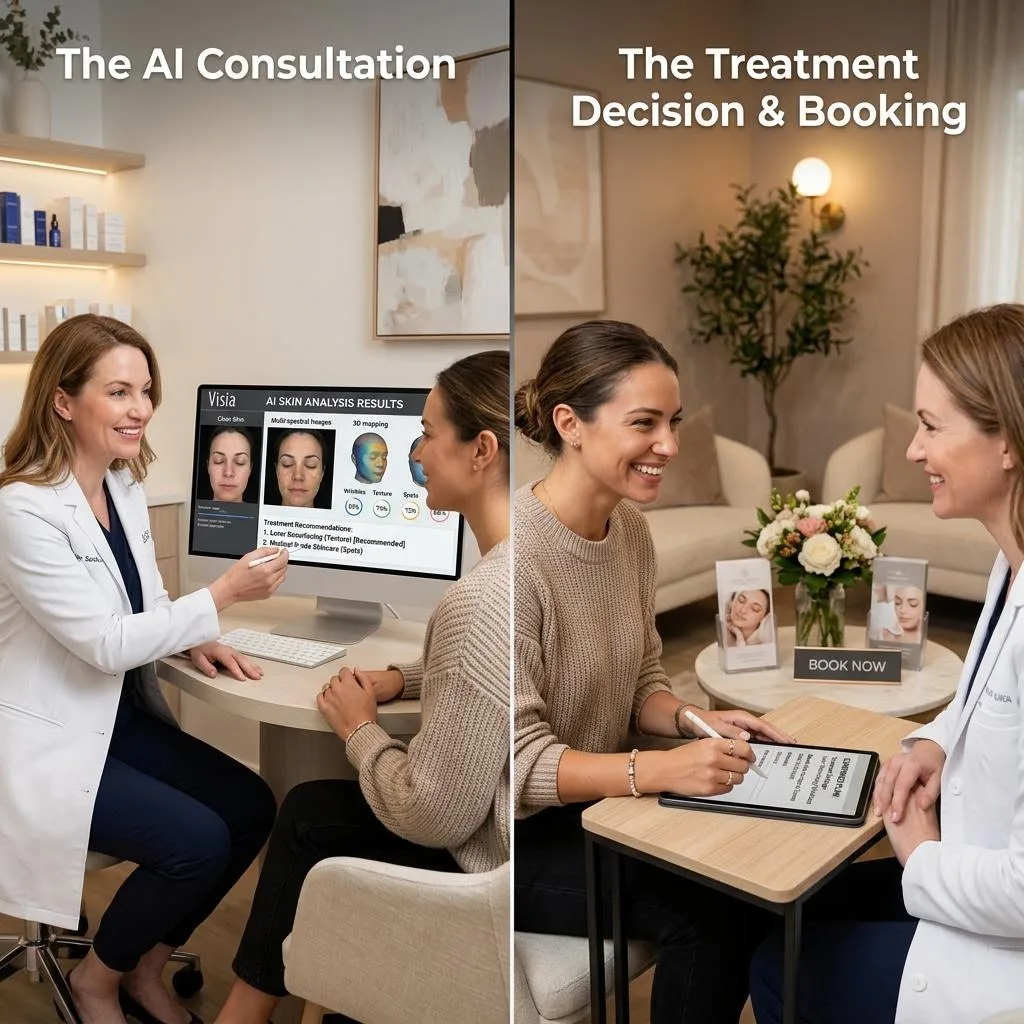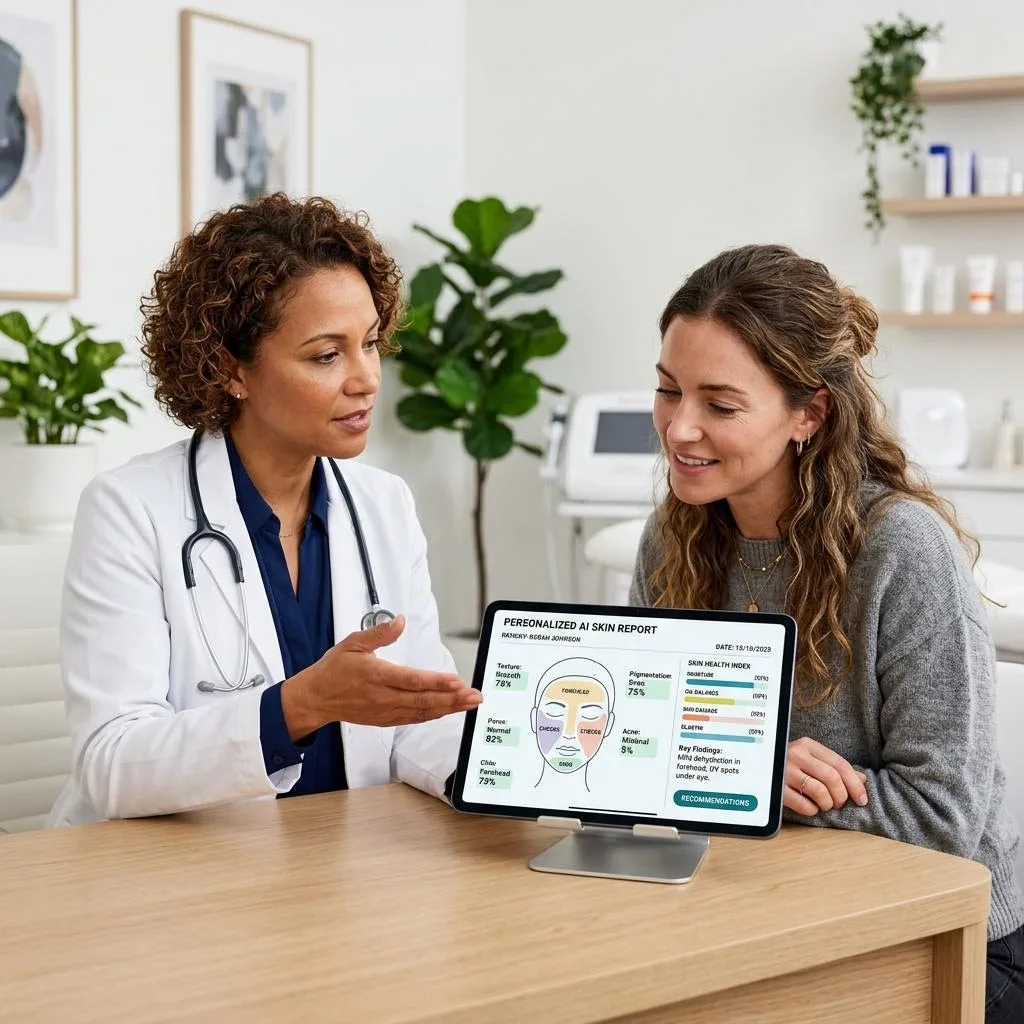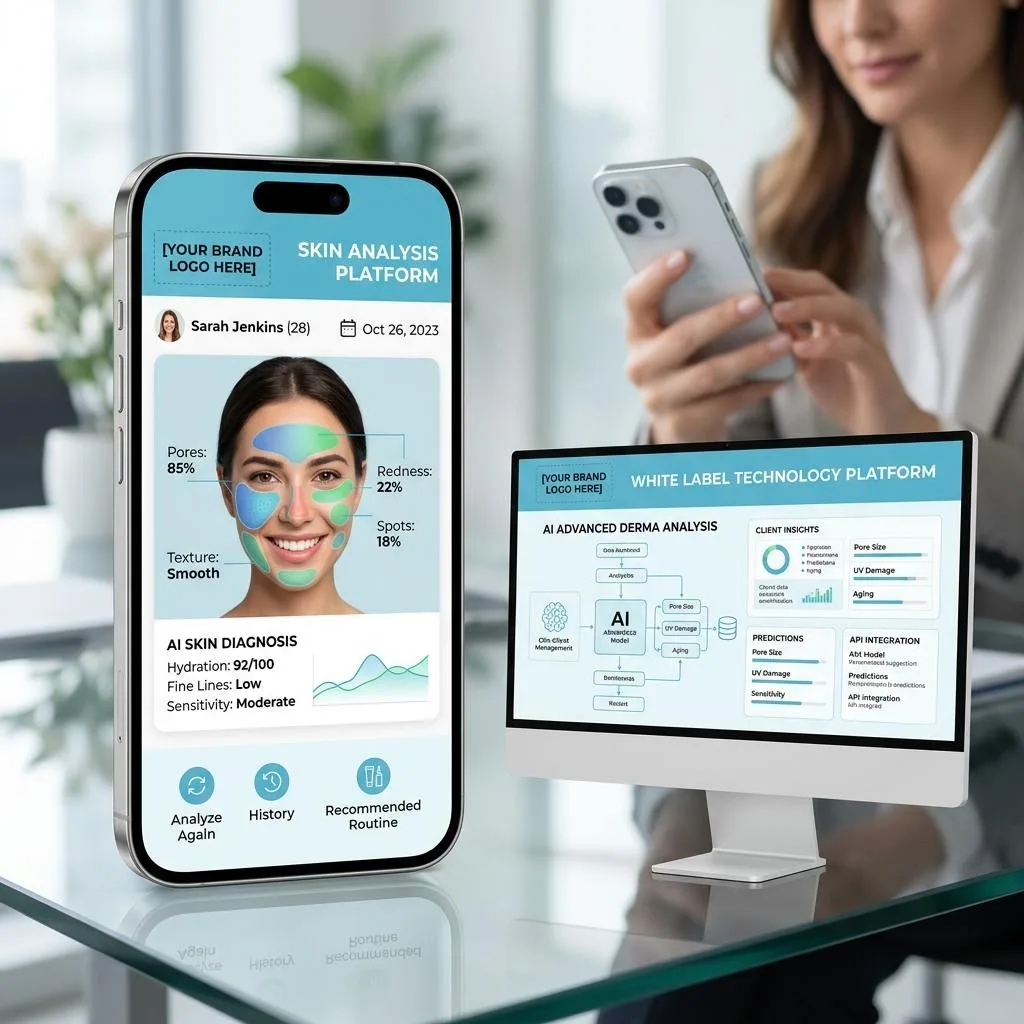
A white label skin analysis solution is a pre-built AI platform that detects skin conditions from facial photographs and delivers personalised product recommendations, deployed entirely under a purchasing brand’s own visual identity and domain. It allows skincare brands, retailers, and private label operators to offer AI-powered personalisation without building proprietary machine learning technology in-house.
Most skincare brands know they need to personalise the shopping experience. The obstacle is the assumption that building an AI skin analysis capability requires a proprietary ML team, a multi-year roadmap, and a dataset of millions of facial images.
That assumption is outdated. White label skin analysis solutions give brands the full commercial benefit of AI-powered personalisation without the engineering overhead. This guide walks brand operators, retail buyers, and private-label manufacturers through what these solutions include, what separates quality providers from mediocre ones, and how to evaluate a platform before signing.
What “White Label” Means in Skin Analysis — and What It Does Not
In the context of skin analysis software, “white label” means the technology is built and maintained by a specialist provider, but deployed under the purchasing brand’s own visual identity and domain. The customer sees the brand — not the underlying technology vendor.
This is distinct from a co-branded integration (where the tech provider’s logo appears alongside the brand’s) and from a generic consumer skin analysis app (which builds audience for the app, not the brand).
A true white label skin analysis solution delivers:
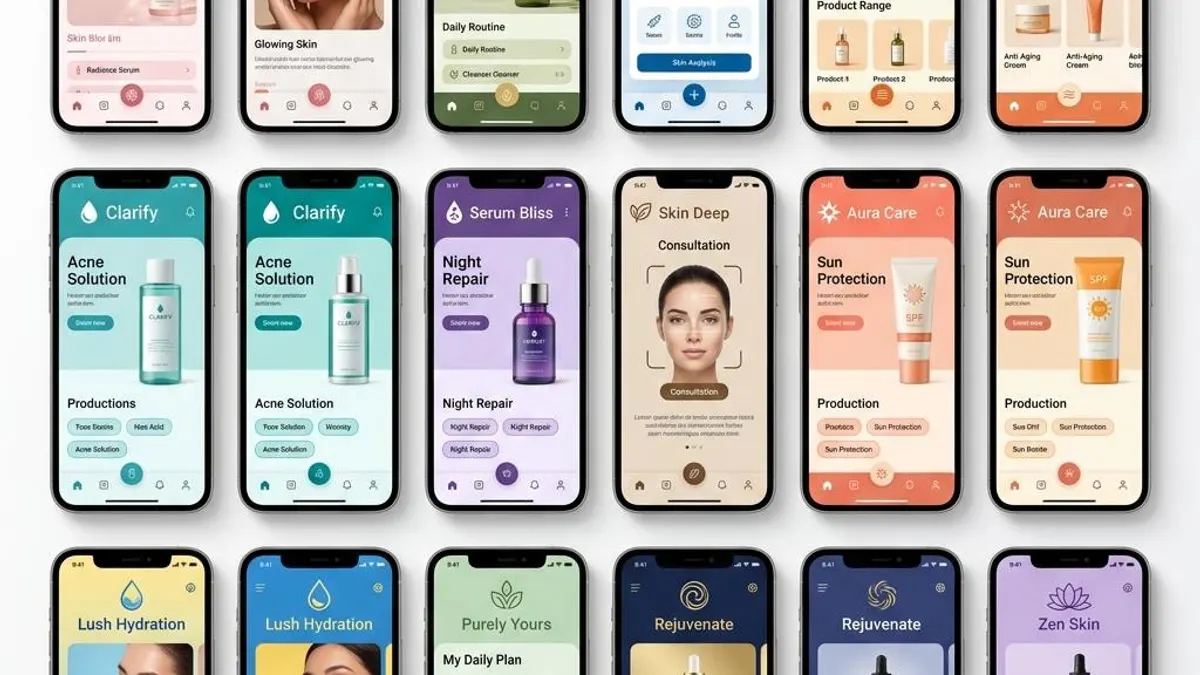
- Full brand customisation of the UI — colours, fonts, logo, tone of voice
- Domain or subdomain deployment under the brand’s own address
- Product recommendation output mapped to the brand’s own SKU catalogue
- Customer data flowing to the brand’s CRM, not to the vendor’s platform
- Compliance-ready infrastructure so the brand, not the vendor, holds the customer relationship
What it does not deliver: proprietary AI ownership. The brand licences the capability; the underlying model continues to be trained and maintained by the provider. For most commercial applications, this is the correct trade-off — the brand benefits from a continually improving model without bearing model maintenance costs (PerfectCorp).
The Business Case for Going White Label Rather Than Building In-House
Time to Market
Building a skin analysis engine from scratch requires a proprietary facial imaging dataset, machine learning engineering resources, dermatological validation partnerships, and ongoing model iteration. End-to-end, this represents a development timeline of 18 months to several years for a credible clinical-accuracy output.
White label deployment — from contract to live integration — can be measured in days to weeks (PerfectCorp). For brands operating in competitive markets where a competitor has already deployed personalisation tools, that timeline gap is commercially decisive.
Accuracy at Launch
A reputable white label provider has already trained its models on large, diverse datasets. Perfect Corp operates on a globally diverse dermatological dataset; Haut.AI reports (per its own materials) 98% diagnostic accuracy trained on over 3 million data points; GlamAR reports being trained on 3+ million data points with a vendor-claimed conversion-rate increase of up to 4x (Glamar). These accuracy and uplift figures are vendor-reported rather than independently audited. A brand building in-house would need years of data collection to approach comparable performance.
Key Takeaway
Key Takeaway: Look beyond the demo — a high-quality white label solution rests on measurable accuracy (for example, some providers cite up to 98% diagnostic accuracy trained on millions of data points) and, just as importantly, clean data ownership terms.
What a High-Quality White Label Skin Analysis Solution Includes
Core Analytical Capability
At minimum, a production-grade platform detects 10–15 skin conditions. Leading solutions cover:
| Concern Category | Specific Detections |
|---|---|
| Acne & breakouts | Active acne, acne-prone areas, acne scarring |
| Pores | Enlarged pores, blackheads |
| Pigmentation | Dark spots, hyperpigmentation, dullness |
| Ageing | Fine lines, wrinkles, skin age estimation |
| Texture | Texture irregularity, rough patches |
| Overall | Skin type classification, skin tone, hydration indicators |
ProSkinScan performs facial zone analysis across T-zone, U-zone, and cheeks separately — recognising that skin behaviour is not uniform across the face — and uses 468 MediaPipe facial landmarks for mapping accuracy.
98%
Diagnostic accuracy trained on 3M+ data points (Haut.AI)
Up to 4×
Conversion-rate increase claim (GlamAR, vendor-reported)
34%
Average order value lift (Haut.AI, vendor-reported)
Personalisation Engine
Skin detection without recommendation output is an observation tool, not a sales tool. The white label solution must include a configurable recommendation engine that maps detected conditions to the brand’s product catalogue. This is where the commercial value is realised: the right serum, the right cleanser, the right SPF — presented as a cohesive routine built around that customer’s specific skin profile.
Revieve’s AI recommendation engine replaces pre-defined merchandising rules with an automated algorithm that draws on selfie diagnostics, user data, and the partner brand’s product inventory to generate personalised routine recommendations (Revieve).
Integration Flexibility
A white label platform serves multiple deployment contexts: website JavaScript embed, mobile app SDK, in-store kiosk or smart mirror, QR code activation from product packaging, and API integration for custom ecommerce builds (Glamar).
Compliance Infrastructure
Customer facial photographs constitute biometric data. Providers must operate GDPR-, CCPA-, and HIPAA-compliant infrastructure (PerfectCorp). ProSkinScan processes facial photos only for analysis and does not store or share them with third parties (app.proskinscan.com).
Use Cases Across Brand and Retail Contexts
Pro Tip
Pro Tip: Anchor the skin analysis tool at the top of the ecommerce funnel as the primary personalisation mechanism — let the scan drive everything downstream, from catalogue matching to product page messaging.
D2C Skincare Brands
The most direct application: anchor the skin analysis tool at the top of the ecommerce funnel as the primary personalisation mechanism. Replace “shop by product type” navigation with “discover your skin routine” as the homepage primary CTA. Haut.AI reports an average increase of roughly 34% in order (cart) value among its customers using AI skin analysis (a vendor-reported figure referring to order value, not total sales).
Multi-Brand Retailers
Retailers face a different challenge: helping customers navigate a large SKU library without overwhelming them. A white label skin analysis tool that spans the entire catalogue — recommending across brands based on detected skin conditions — increases basket size, reduces returns, and ensures the retailer owns the customer relationship and data.
Private Label Manufacturers
For contract manufacturers building branded ranges for salon groups, hotel chains, or specialty retailers, a white label skin analysis capability differentiates the offer. The manufacturer provides a full personalisation stack — product plus the AI tool that sells it — raising the value of the contract and the stickiness of the client relationship.
Subscription Skincare Boxes
Subscription businesses face high churn driven by product-fit mismatches. Embedding a skin analysis onboarding flow reduces early churn by anchoring curation to objective skin data rather than self-reported quiz answers — which are notoriously unreliable for complex, multi-layered concerns.
Common Mistakes When Evaluating White Label Skin Analysis Vendors
Mistake 1: Choosing on Demo Aesthetics Alone
A polished demo interface does not predict integration performance. Ask for data on API uptime, response latency (scan-to-result time), and mobile performance on mid-range Android devices.
Mistake 2: Not Specifying Catalogue Mapping Requirements Upfront
Vendors often sell the analysis capability separately from the recommendation engine configuration. Clarify upfront whether catalogue configuration is included in the implementation fee or billed separately.
Important
Important: Models trained predominantly on lighter skin tones perform significantly worse on darker skin. Insist on accuracy verified against the skin-tone diversity of your actual customer base, not a single glossy benchmark.
Mistake 3: Accepting Generic Accuracy Claims Without Demographic Specificity
“95% accuracy” means little without knowing which skin tones and ethnicities were included in the validation set. AI models trained predominantly on lighter Fitzpatrick skin types perform significantly worse on darker skin tones — a business-critical gap for brands serving Southeast Asian, African, or Latin American markets.
Mistake 4: Ignoring the Data Ownership Clause
Some platforms retain the right to use anonymised scan data to train their models — standard practice — but others retain rights to share aggregated insights with third parties. Read the data processing agreement carefully.
How to Evaluate a White Label Skin Analysis Platform: A Decision Framework
| Evaluation Criterion | What to Assess | Red Flag |
|---|---|---|
| Analytical depth | Number and granularity of conditions detected | Fewer than 10 conditions, no zone-level analysis |
| Recommendation engine | Catalogue mapping, routine logic, SKU specificity | Generic recommendations not tied to brand SKUs |
| Integration options | API, SDK, embed — all present | Single integration method only |
| Customisation | Full UI branding, tone of voice, URL | Vendor logo or co-branding required |
| Data compliance | GDPR, CCPA coverage; facial data handling | Vague data policy, no DPA available |
| Accuracy validation | Dermato-validated, diverse skin tones | Single-market training data |
| Implementation timeline | Days-to-weeks for standard integrations | Months-long professional services required |
Implementation Roadmap: From Contract to Live Deployment
| Phase | Timeline | Key Actions |
|---|---|---|
| Configuration | Week 1–2 | Map product catalogue to skin conditions; define routine logic; configure UI to brand identity |
| Integration | Week 2–3 | Connect via API/SDK/embed; route data to CRM or email platform |
| QA and Testing | Week 3–4 | Test across iOS, Android, desktop; validate recommendation logic; confirm data compliance |
| Launch | Week 4+ | Deploy on homepage hero; email existing customers; use as PR moment |
Configuration
Week 1–2: catalogue mapping, brand UI
Integration
Week 2–3: API/SDK/embed, CRM routing
QA & Testing
Week 3–4: cross-device validation
Launch
Week 4+: homepage rollout, PR moment

Frequently Asked Questions
Q1: What is the difference between a white label skin analysis solution and building a custom AI skin analysis tool?
A white label solution licences a pre-built, vendor-maintained AI engine that the brand deploys under its own identity. A custom build requires developing the AI model from scratch — including data collection, training, and validation — which typically takes 18+ months and significant engineering investment. White label provides comparable or superior analytical capability at a fraction of the cost and timeline (PerfectCorp).
Q2: Can the recommendation output be restricted to the brand’s own product catalogue?
Yes — this is a core requirement of any commercial white label deployment. The recommendation engine should be configured to map detected skin conditions exclusively to the brand’s SKUs, not to generic ingredient categories or third-party products.
Q3: Is the solution suitable for in-store deployment as well as online?
Yes. White label skin analysis platforms support omnichannel deployment including in-store kiosks, tablet-based consultations, and QR code activations — with all data flowing to a single customer record (PerfectCorp).
Q4: How is the white label solution different from what clinics use?
Aesthetic clinics typically require deeper clinical analysis tools — progress tracking across treatment cycles, pre- and post-procedure imaging, and integration with clinic management software. A brand-facing white label solution is optimised for conversion and personalisation at the ecommerce layer. ProSkinScan serves both segments: the brand demo is available at app.proskinscan.com, while the clinic-facing tool is deployed at qderma.proskinscan.com.
Q5: What happens to customer facial data after the scan is complete?
ProSkinScan processes facial photographs exclusively for the analysis session and does not store or share them with third parties (app.proskinscan.com). Always request explicit confirmation of facial data retention policy, third-party sharing rights, and compliance certifications before deployment.
Q6: How does a white label skin analysis solution generate ROI?
ROI is driven by three levers: higher conversion rate (industry benchmarks suggest figures in the 30–34% range), higher AOV through routine-based purchasing, and lower return rates from more accurate product matching. Validate these levers with your own A/B test rather than assuming the benchmark.
The Next Step
White label skin analysis has moved from competitive advantage to table stakes in markets where personalisation is the expectation.
ProSkinScan is an AI skin analysis platform built for skincare brands and retailers, deployable under your brand identity with product recommendations mapped to your catalogue. The full analysis experience is available to evaluate without any sign-up required.